

Unsloth Dynamic 2.0 Quants
Collection
New 2.0 version of our Dynamic GGUF + Quants. Dynamic 2.0 achieves superior accuracy & SOTA quantization performance. • 119 items • Updated • 812
Unsloth Dynamic 3.0 achieves superior accuracy & outperforms other leading quants.



As the frontier of foundation models pushes toward ever-larger parameter counts and ever-longer context windows, the question is no longer just how much we can scale, but how efficiently we can do so. Sustainable progress toward artificial general intelligence (AGI) that benefits everyone demands architectural innovation. Today, we are sharing a concrete step in that direction: Qwen3.8-Flash-Next.
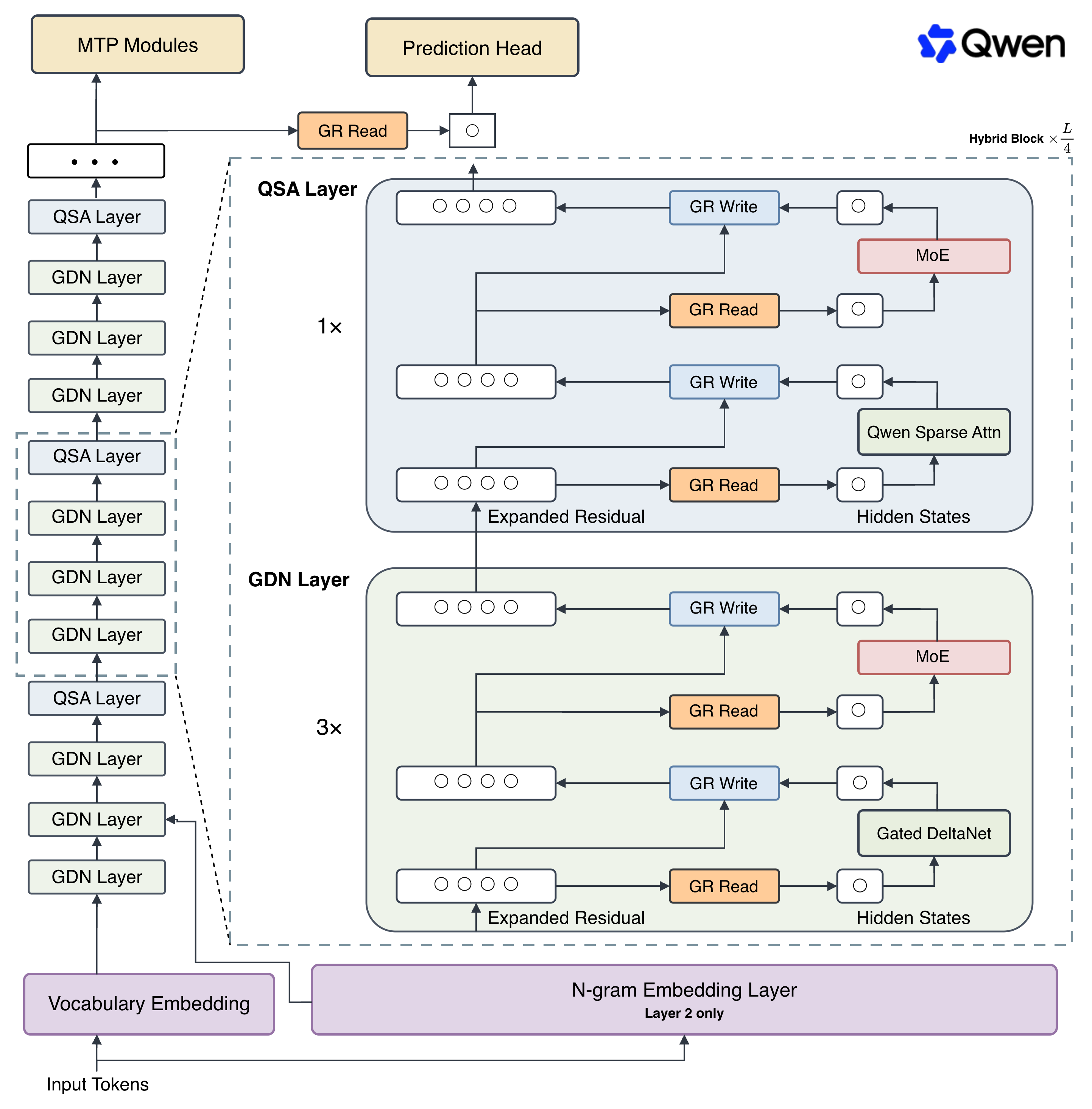
This experimental preview of the architecture that will underpin Qwen4 is built around a fundamental rethinking of how the core components of modern large language models (LLMs) interact at scale.
The first open-weight release under this architecture is Qwen3.8-Flash-Next, which introduces:
For more details, please refer to our blog post Qwen3.8-Flash-Next and the technical report.
We are excited to embark on this next chapter with you and welcome your feedback as we build what comes next.
| Qwen3.8-Flash-Next | Qwen3.8-27B | Qwen3.7-Plus | DeepSeek-V4-Flash-0731 | Claude-Opus-4.6 (Max) | |
|---|---|---|---|---|---|
# Params |
125B | 27B | 397B | 284B | -- |
# Activated params |
6B | 27B | 17B | 13B | -- |
# N-gram embedding params |
51B | -- | -- | -- | -- |
| Coding | |||||
Agentic coding DeepSWE 1.1 |
58.7 | 42.2 | 16.5 | 54.4 | -- |
Agentic coding SWE-bench Pro |
62.5 | 61.7 | 55.8 | 56.0 | 53.4 |
Multilingual software engineering SWE-bench Multilingual |
81.0 | 73.8 | 75.8 | -- | 77.5 |
Repo-level code generation NL2Repo-Bench |
48.1 | 42.3 | 41.1 | 54.2 | 47.6 |
| Agent | |||||
Long-horizon office work CoWorkBench |
73.9 | 70.7 | 65.1 | 45.1 | 68.2 |
Professional job tasks JobBench |
55.7 | 33.4 | 27.6 | 41.3 | 36.6 |
Frontier agentic tasks Agents' Last Exam |
Pass@1 24.3 Score 51.2 |
Pass@1 20.4 Score 42.9 |
Pass@1 13.2 Score 33.6 |
Pass@1 25.2 Score -- |
-- |
Real-world tool use Toolathlon Verified (Pass@1) |
73.5 | 67.1 | 50.6 | 70.3 | -- |
| General | |||||
Instruction following IFBench |
81.3 | 79.5 | 79.1 | 79.2 | 62.5 |
Scientific reasoning GPQA Diamond |
91.7 | 89.2 | 90.3 | 90.8 | 91.3 |
Multidisciplinary reasoning HLE |
35.9 | 30.8 | 34.7 | 33.8 | 40.0 |
Competitive coding LiveCodeBench v6 |
91.9 | 90.3 | 89.6 | 90.6 | 88.8 |
1. DeepSWE 1.1: evaluated with the Claude Code and mini-SWE-agent harnesses, temp=1.0, top_p=0.95, 256K context window. We report the highest score across the two harnesses; notably, Qwen3.8-Flash-Next performs best on mini-SWE-agent.
2. SWE-bench Pro: except for Claude-Opus-4.6 (Max), for which we report the officially published score, all models are evaluated with the Claude Code harness, temp=1.0, top_p=0.95, 256K context window. Problematic tasks were corrected and all baseline models were re-evaluated on the refined benchmark.
3. SWE-bench Multilingual: evaluated with the mini-SWE-agent harness, temp=1.0, top_p=0.95, 256K context window.
4. NL2Repo-Bench: evaluated with the Claude Code harness. To prevent reward hacking, we disable Bash commands that attempt to access the specific repository, such as pip download, pip install and git clone.
5. CoWorkBench: an in-house cowork benchmark for evaluating long-horizon office and productivity agent tasks across computer science, finance, law, medical and other productivity domains.
6. HLE: judged by GPT-4o.
7. The best result in each row is shown in bold.
8. Empty cells (--): scores are not yet available or are not applicable.
| Qwen3.8-Flash-Next | Qwen3.8-27B | Qwen3.7-Plus | Claude-Opus-4.6 (Max) | |
|---|---|---|---|---|
| Agentic Multimodal Intelligence | ||||
Multimodal tool use ClawEval-MM |
Pass@3 64.4 Average 60.4 |
Pass@3 57.4 Average 56.9 |
Pass@3 57.4 Average 60.1 |
Pass@3 52.5 Average 54.7 |
Application recreation RecreationBench |
49.9 | 47.1 | 30.2 | -- |
Mobile use AndroidWorld |
84.5 | 81.9 | 81.0 | 62.0 |
Computer use OSWorld 2.0 |
Binary 19.4 Partial 52.3 |
Binary 19.4 Partial 48.0 |
Binary 2.8 Partial 21.5 |
-- |
Visual web development Vision2Web |
64.0 | 62.9 | 42.1 | -- |
| General Multimodal Intelligence | ||||
Embodied intelligence ERQA |
72.3 | 65.5 | 69.8 | 40.8 |
Long video understanding LVBench |
76.6 | 72.4 | 76.2 | 63.0 |
Real-world perception RealWorldQA |
88.5 | 85.9 | 86.9 | 73.9 |
Visual math problem solving MathVision |
Without CI 90.6 With CI 95.7 |
Without CI 90.0 With CI 94.6 |
Without CI 90.3 With CI 88.7 |
Without CI 65.5 |
Scientific chart analysis CharXiv (RQ) |
Without CI 84.6 With CI 90.6 |
Without CI 83.7 With CI 90.2 |
Without CI 85.8 With CI 85.9 |
Without CI 66.0 |
1. ClawEval-MM: scores are reported as "pass@3 / average score". Pass@3 measures the percentage passed in at least one of three trials, and the average score is the mean score across the three trials.
2. RecreationBench: an in-house long-horizon application-recreation benchmark for evaluating hybrid-agent abilities spanning five platforms — desktop (Ubuntu, macOS, Windows), mobile (Android) and web.
3. OSWorld 2.0: scores are reported as "binary / partial". The binary score is the percentage of tasks that receive the full task reward, while the partial score aggregates the partial rewards obtained across all tasks.
4. Vision2Web: scores are reported as the average over the frontend, webpage and website categories, using the Claude Code harness and judged by gpt-5.4-2026-03-05.
5. MathVision, CharXiv (RQ): scores are reported as "without CI / with CI". A small number of incorrect ground-truth annotations in MathVision were corrected after manual verification. Our model's score is evaluated using a fixed prompt, e.g. "Please reason step by step, and put your final answer within \boxed{}." For other models, we report the higher score between runs with and without the \boxed{} formatting.
6. The best result in each row is shown in bold.
7. Empty cells (--) indicate scores not yet available or not applicable.
Qwen3.8-Flash-Next models operate in thinking mode by default, generating thinking content signified by
<think>\n...</think>\n\nbefore producing the final responses. To disable thinking content and obtain direct response, refer to the examples here.
We recommend using the following sets of sampling parameters for generation:
- Thinking Mode:
temperature=1.0,top_p=0.95,top_k=20,min_p=0.0,presence_penalty=0.0,repetition_penalty=1.0- Instruct (or non-thinking) mode:
temperature=0.7,top_p=0.80,top_k=20,min_p=0.0,presence_penalty=1.5,repetition_penalty=1.0Please note that the support for sampling parameters varies according to inference frameworks.
In multi-turn agentic tasks, lower reasoning effort does not always reduce overall task completion time. Although it may produce faster per-turn responses, it can also lead to insufficient analysis, more failures, and repeated retries, which may increase total latency and token consumption.
Qwen3.8-Flash-Next supports controlling thinking behavior via enable_thinking, preserve_thinking, and reasoning_effort.
t; supported levels are xhigh, medium, and low stream=True, stream_options={"include_usage": True}, )
Qwen3.8-Flash-Next will think by default before responding. You can obtain a direct response from the model without thinking by configuring the API parameters. For example,
from openai import OpenAI
# Configured by environment variables
client = OpenAI()

messages = [
    {
        "role": "user",
        "content": [
            {
                "type": "image_url",
                "image_url": {
                    "url": "https://qianwen-res.oss-accelerate.aliyuncs.com/Qwen3.5/demo/RealWorld/RealWorld-04.png"
                }
            },
            {
                "type": "text",
                "text": "Where is this?"
            }
        ]
    }
]

chat_response = client.chat.completions.create(
    model="Qwen/Qwen3.8-Flash-Next",
    messages=messages,
    temperature=0.7,
    top_p=0.8,
    presence_penalty=1.5,
    extra_body={
        "top_k": 20,
        "chat_template_kwargs": {"enable_thinking": False},
    },
)
print("Chat response:", chat_response)
If you are using APIs from Qwen Cloud, in addition to changing
model, please use"enable_thinking": Falseinstead of"chat_template_kwargs": {"enable_thinking": False}.
By default, Qwen3.8-Flash-Next retains thinking blocks from all historical messages, maintaining a complete reasoning trace across the conversation. This behavior, known as preserved thinking, ensures full context continuity and is especially beneficial for agent scenarios where decision consistency and reduced redundant reasoning are critical. It also improves KV cache utilization, optimizing inference efficiency in both thinking and non-thinking modes.
If you prefer to retain only the thinking blocks from the latest user message, you can disable this behavior by setting preserve_thinking to False:
from openai import OpenAI

# Configured by environment variables
client = OpenAI()
messages = [...]
chat_response = client.chat.completions.create(
    model="Qwen/Qwen3.8-Flash-Next",
    messages=messages,
    extra_body={
        "chat_template_kwargs": {"preserve_thinking": False},
    },
)
print("Chat response:", chat_response)
If you are using APIs from Qwen Cloud, in addition to changing
model, please use"preserve_thinking": Falsedirectly instead of wrapping it inchat_template_kwargs.
To achieve optimal performance, we recommend the following settings:
Sampling Parameters: We suggest using the following sets of sampling parameters:
temperature=1.0, top_p=0.95, top_k=20, min_p=0.0, presence_penalty=0.0, repetition_penalty=1.0temperature=0.7, top_p=0.80, top_k=20, min_p=0.0, presence_penalty=1.5, repetition_penalty=1.0 For supported frameworks, you can adjust the presence_penalty parameter between 0 and 2 to reduce endless repetition. However, using a higher value may occasionally result in language mixing and a slight decrease in model performance.
Adequate Output Length: To optimize performance on agentic tasks, we recommend allocating sufficient output length to allow the model to generate detailed and comprehensive responses. For frameworks that support separate token limits for internal reasoning and final outputs, we suggest the following configuration within the 1M context length:
These settings provide the necessary capacity for complex reasoning while ensuring ample space for high-quality final deliverables.
Processing Ultra-Long Texts: Qwen3.8-Flash-Next natively supports context lengths of up to 262,144 tokens. For long-horizon tasks where the total length (including both input and output) exceeds this limit, we recommend using RoPE scaling techniques to handle long texts effectively, e.g., YaRN.
YaRN is currently supported by several inference frameworks, e.g., vLLM, SGLang, and TokenSpeed. In general, there are two approaches to enabling YaRN for supported frameworks:
Modifying the model configuration file:
In the config.json file, change the rope_parameters fields in text_config to:
{
    "mrope_interleaved": true,
    "mrope_section": [
        11,
        11,
        10
    ],
    "rope_type": "yarn",
    "rope_theta": 10000000,
    "partial_rotary_factor": 0.25,
    "factor": 4.0,
    "original_max_position_embeddings": 262144
}
All the notable open-source frameworks implement static YaRN, which means the scaling factor remains constant regardless of input length, potentially impacting performance on shorter texts. We advise modifying the
rope_parametersconfiguration only when processing long contexts is required. It is also recommended to modify thefactoras needed. For example, if the typical context length for your application is 524,288 tokens, it would be better to setfactoras 2.0.
Long Video Understanding: To optimize inference efficiency for plain text and images, the size parameter in the released video_preprocessor_config.json is conservatively configured. It is recommended to set the longest_edge parameter in the video_preprocessor_config file to 469,762,048 (corresponding to 224k video tokens) to enable higher frame-rate sampling for hour-scale videos and thereby achieve superior performance. For example,
{"longest_edge": 469762048, "shortest_edge": 4096}
Alternatively, override the default values via engine startup parameters. For implementation details, refer to: vLLM / SGLang.
If you find our work helpful, feel free to give us a cite.
@techreport{qwen2026design,
    title       = {On the Design of {Qwen3.8-Next} Architecture: Evaluation, Efficiency, and Training Stability},
    author      = {{Qwen Team}},
    institution = {Alibaba Group},
    month       = {August},
    year        = {2026}
}

@misc{qwen3.8flashnext,
    title  = {{Qwen3.8-Flash-Next}: A New Architecture, Towards Ultimate Cost-Efficiency},
    author = {{Qwen Team}},
    month  = {August},
    year   = {2026},
    url    = {https://qwen.ai/blog?id=qwen3.8-flash-next}
}
1-bit
2-bit
3-bit
4-bit
Base model
Qwen/Qwen3.8-Flash-Next
docker model run hf.co/unsloth/Qwen3.8-Flash-Next-GGUF: