Instructions to use MiniMaxAI/MiniMax-M3 with libraries, inference providers, notebooks, and local apps. Follow these links to get started.
- Libraries
- Transformers
How to use MiniMaxAI/MiniMax-M3 with Transformers:
# Use a pipeline as a high-level helper from transformers import pipeline pipe = pipeline("image-text-to-text", model="MiniMaxAI/MiniMax-M3", trust_remote_code=True) messages = [ { "role": "user", "content": [ {"type": "image", "url": "https://huggingface.co/datasets/huggingface/documentation-images/resolve/main/p-blog/candy.JPG"}, {"type": "text", "text": "What animal is on the candy?"} ] }, ] pipe(text=messages)# Load model directly from transformers import AutoProcessor, AutoModelForMultimodalLM processor = AutoProcessor.from_pretrained("MiniMaxAI/MiniMax-M3", trust_remote_code=True) model = AutoModelForMultimodalLM.from_pretrained("MiniMaxAI/MiniMax-M3", trust_remote_code=True) messages = [ { "role": "user", "content": [ {"type": "image", "url": "https://huggingface.co/datasets/huggingface/documentation-images/resolve/main/p-blog/candy.JPG"}, {"type": "text", "text": "What animal is on the candy?"} ] }, ] inputs = processor.apply_chat_template( messages, add_generation_prompt=True, tokenize=True, return_dict=True, return_tensors="pt", ).to(model.device) outputs = model.generate(**inputs, max_new_tokens=40) print(processor.decode(outputs[0][inputs["input_ids"].shape[-1]:])) - Inference
- HuggingChat
- Notebooks
- Google Colab
- Kaggle
- Local Apps Settings
- vLLM
How to use MiniMaxAI/MiniMax-M3 with vLLM:
Install from pip and serve model
# Install vLLM from pip: pip install vllm # Start the vLLM server: vllm serve "MiniMaxAI/MiniMax-M3" # Call the server using curl (OpenAI-compatible API): curl -X POST "http://localhost:8000/v1/chat/completions" \ -H "Content-Type: application/json" \ --data '{ "model": "MiniMaxAI/MiniMax-M3", "messages": [ { "role": "user", "content": [ { "type": "text", "text": "Describe this image in one sentence." }, { "type": "image_url", "image_url": { "url": "https://cdn.britannica.com/61/93061-050-99147DCE/Statue-of-Liberty-Island-New-York-Bay.jpg" } } ] } ] }'Use Docker
docker model run hf.co/MiniMaxAI/MiniMax-M3
- SGLang
How to use MiniMaxAI/MiniMax-M3 with SGLang:
Install from pip and serve model
# Install SGLang from pip: pip install sglang # Start the SGLang server: python3 -m sglang.launch_server \ --model-path "MiniMaxAI/MiniMax-M3" \ --host 0.0.0.0 \ --port 30000 # Call the server using curl (OpenAI-compatible API): curl -X POST "http://localhost:30000/v1/chat/completions" \ -H "Content-Type: application/json" \ --data '{ "model": "MiniMaxAI/MiniMax-M3", "messages": [ { "role": "user", "content": [ { "type": "text", "text": "Describe this image in one sentence." }, { "type": "image_url", "image_url": { "url": "https://cdn.britannica.com/61/93061-050-99147DCE/Statue-of-Liberty-Island-New-York-Bay.jpg" } } ] } ] }'Use Docker images
docker run --gpus all \ --shm-size 32g \ -p 30000:30000 \ -v ~/.cache/huggingface:/root/.cache/huggingface \ --env "HF_TOKEN=<secret>" \ --ipc=host \ lmsysorg/sglang:latest \ python3 -m sglang.launch_server \ --model-path "MiniMaxAI/MiniMax-M3" \ --host 0.0.0.0 \ --port 30000 # Call the server using curl (OpenAI-compatible API): curl -X POST "http://localhost:30000/v1/chat/completions" \ -H "Content-Type: application/json" \ --data '{ "model": "MiniMaxAI/MiniMax-M3", "messages": [ { "role": "user", "content": [ { "type": "text", "text": "Describe this image in one sentence." }, { "type": "image_url", "image_url": { "url": "https://cdn.britannica.com/61/93061-050-99147DCE/Statue-of-Liberty-Island-New-York-Bay.jpg" } } ] } ] }' - Docker Model Runner
How to use MiniMaxAI/MiniMax-M3 with Docker Model Runner:
docker model run hf.co/MiniMaxAI/MiniMax-M3
# Load model directly
from transformers import AutoProcessor, AutoModelForMultimodalLM
processor = AutoProcessor.from_pretrained("MiniMaxAI/MiniMax-M3", trust_remote_code=True)
model = AutoModelForMultimodalLM.from_pretrained("MiniMaxAI/MiniMax-M3", trust_remote_code=True)
messages = [
{
"role": "user",
"content": [
{"type": "image", "url": "https://huggingface.co/datasets/huggingface/documentation-images/resolve/main/p-blog/candy.JPG"},
{"type": "text", "text": "What animal is on the candy?"}
]
},
]
inputs = processor.apply_chat_template(
messages,
add_generation_prompt=True,
tokenize=True,
return_dict=True,
return_tensors="pt",
).to(model.device)
outputs = model.generate(**inputs, max_new_tokens=40)
print(processor.decode(outputs[0][inputs["input_ids"].shape[-1]:]))MiniMax-M3 is a native multimodal model with 1M context. It has ~428B parameters and ~23B activated parameters.

Highlights:
- Native Multimodality: M3 undergoes mixed-modality training from the very first step, enabling deeper semantic fusion across text, image, and video.
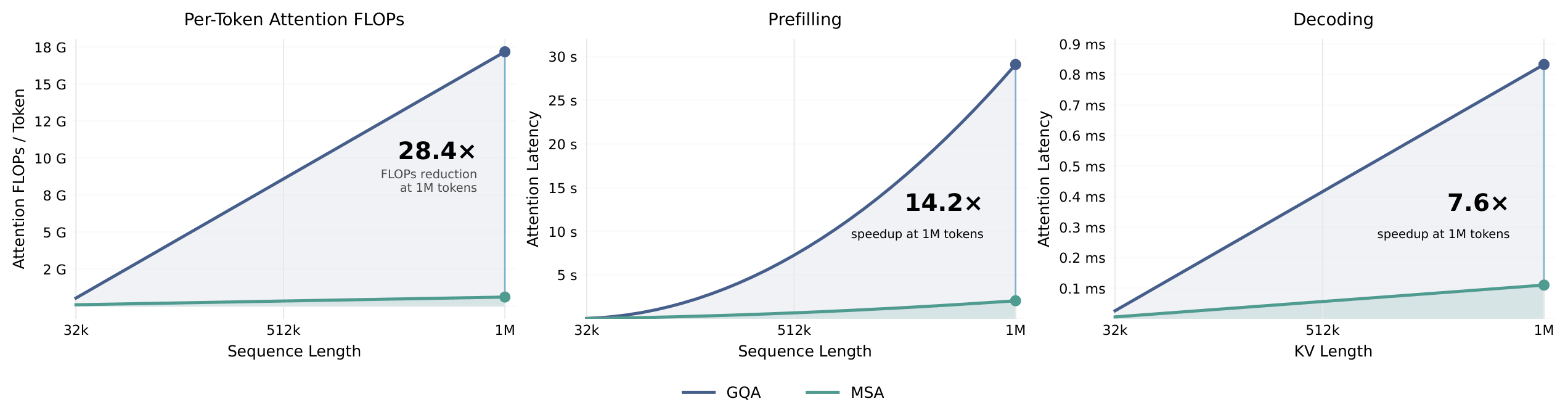
- Context Scaling via Sparse Attention: M3 introduces MiniMax Sparse Attention (MSA) to improve long context efficiency. M3 delivers 9× prefill and 15× decode speedups compared to M2 at 1M context, reducing per-token compute to 1/20.
- Coding & Cowork Capability: M3 achieves frontier-level performance across long-horizon agentic benchmarks, excelling in both coding and cowork.
MiniMax Sparse Attention (MSA)
M3 is powered by MiniMax Sparse Attention (MSA), a high-performance sparse attention operator designed for million-token contexts. Compared with GQA, MSA dramatically reduces the attention compute and memory footprint while preserving model quality.
📄 Read the technical report: arXiv:2606.13392 · Hugging Face Papers
How to Use
M3 supports two reasoning modes:
- thinking — for complex reasoning, agentic tasks, and long-horizon collaboration.
- non-thinking — for latency-sensitive scenarios such as chat and code completion.
Local Deployment
Download the model:
hf download MiniMaxAI/MiniMax-M3 --local-dir MiniMax-M3
We recommend the following inference frameworks (listed alphabetically) to serve the model:
SGLang - see SGLang cookbook.
vLLM - see vLLM recipes.
Transformers - see Transformers docs.
Inference Parameters
We recommend the following parameters for best performance: temperature=1.0, top_p=0.95, top_k=40.
Contact Us
Contact us at model@minimax.io.
- Downloads last month
- 442
# Use a pipeline as a high-level helper from transformers import pipeline pipe = pipeline("image-text-to-text", model="MiniMaxAI/MiniMax-M3", trust_remote_code=True) messages = [ { "role": "user", "content": [ {"type": "image", "url": "https://huggingface.co/datasets/huggingface/documentation-images/resolve/main/p-blog/candy.JPG"}, {"type": "text", "text": "What animal is on the candy?"} ] }, ] pipe(text=messages)