

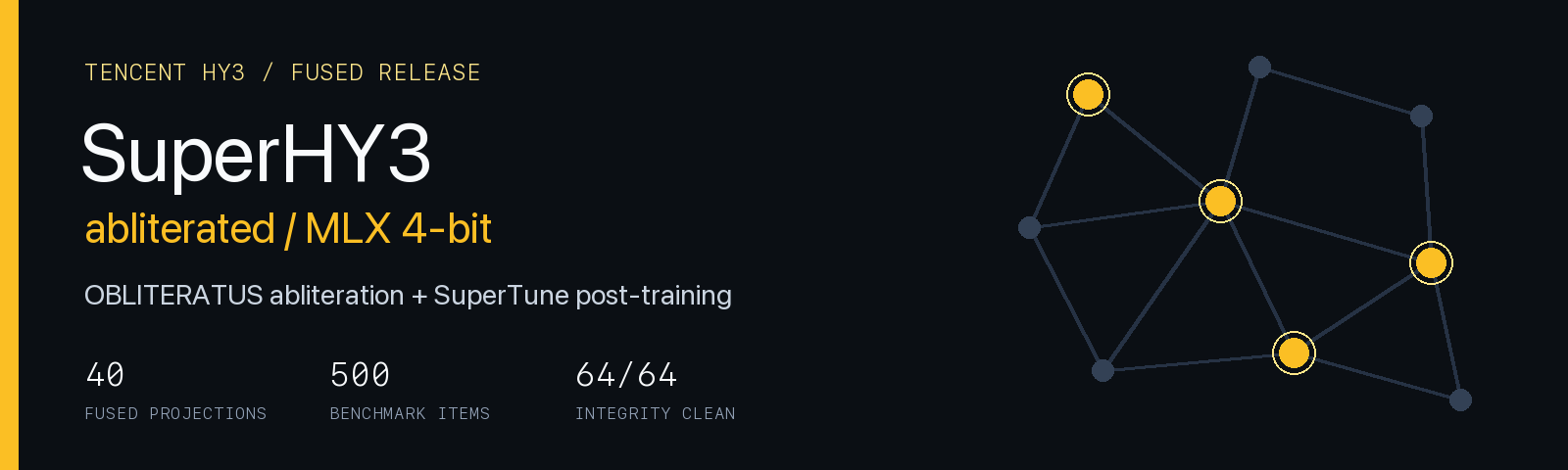
SuperHY3-abliterated-MLX-4bit
The high-memory Apple Silicon edition of SuperHY3, with the same fused OBLITERATUS and SuperTune behavior as the NVFP4 release.




This is the MLX 4-bit companion to
SuperHY3-abliterated-NVFP4.
The behavioral update and release chat template are the same; the storage format
is optimized for high-memory Apple Silicon instead of NVIDIA NVFP4 serving.
The checkpoint is fully fused. No LoRA, adapter, or runtime weight patch is required.
Release Highlights
| Base quantization | imatrix-enhanced affine MLX 4-bit, group size 64 |
| Release size | approximately 171 GB across 32 safetensors shards |
| Fused update | 40 attention output projections across layers 39-78 |
| Mixed precision | original 4-bit placements retained; 40 edited projections stored in BF16 |
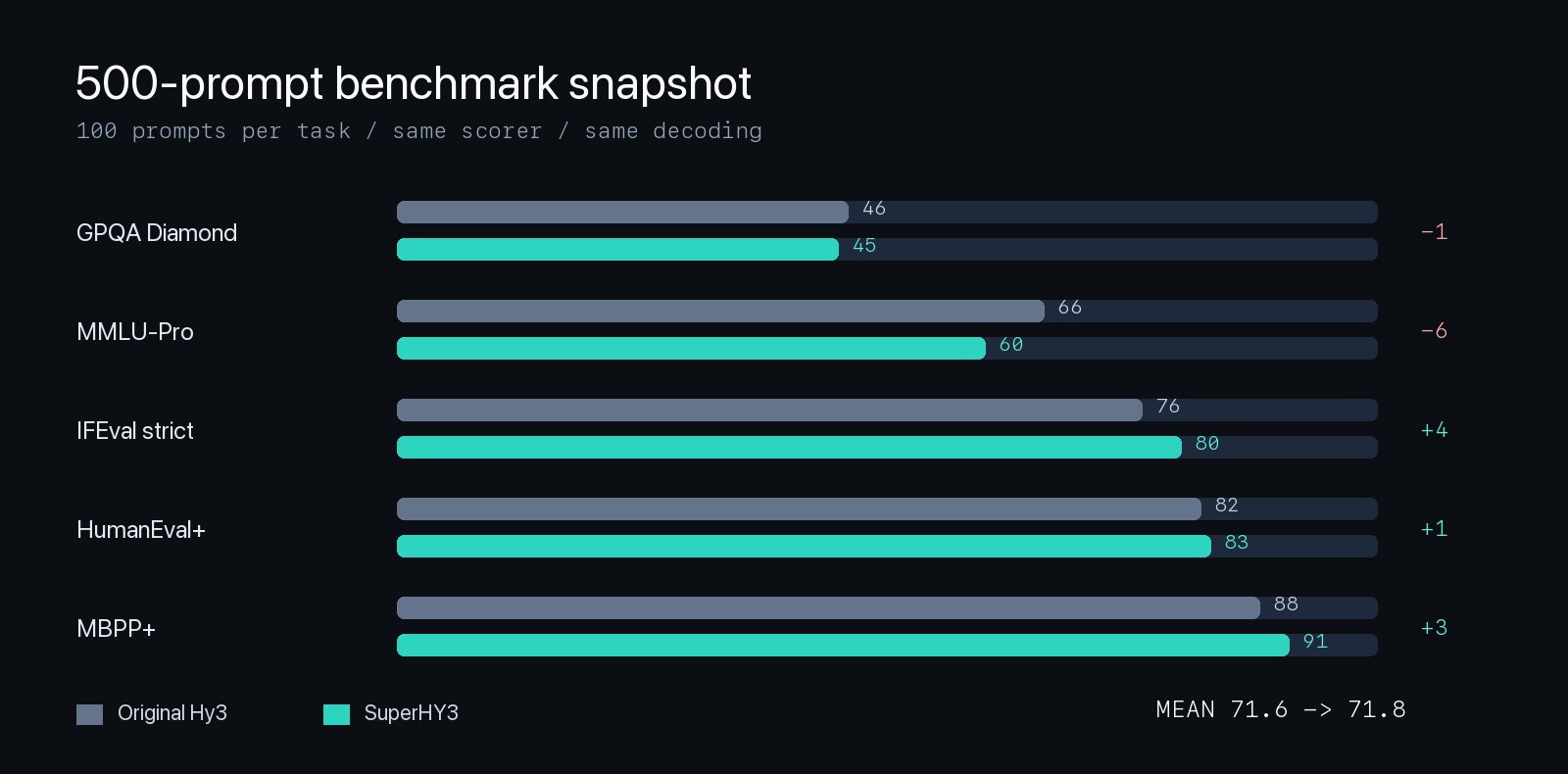
| 500-prompt mean | 71.6 -> 71.8 against the original Hy3 runtime |
| Response integrity | 64/64 refusal-suite responses clean; 12/12 runtime audit cases passed |
| Artifact verification | 52/52 Hub files checksum-verified; release gate passed with 0 blockers |
Why the edited projections stay in BF16
The model was fused from
unigilby/Hy3-oQ4e. Its calibrated
4-bit placements remain unchanged except for the 40 attention output
projections carrying the post-training update. Those projections are stored in
BF16 to avoid applying a second quantization pass to the newly fused deltas.
This produces a larger checkpoint than the 158 GB source quantization, but preserves the exact validated update instead of rounding it back into 4-bit groups.
Benchmark Snapshot
| Benchmark | Original Hy3 | SuperHY3 | Delta |
|---|---|---|---|
| GPQA Diamond | 46.0 | 45.0 | -1.0 |
| MMLU-Pro | 66.0 | 60.0 | -6.0 |
| IFEval strict prompt accuracy | 76.0 | 80.0 | +4.0 |
| HumanEval+ pass@1 | 82.0 | 83.0 | +1.0 |
| MBPP+ pass@1 | 88.0 | 91.0 | +3.0 |
| Five-task mean | 71.6 | 71.8 | +0.2 |
The same preserved 500 prompts and scorer were used for both sides. Invalid-response, blank-response, and thought-leak ratios were all 0.0.
The behavioral benchmark used a runtime-matched GGUF overlay with the exact same 40 projection deltas and release chat template. The fused MLX artifact was structurally verified rather than loaded on the 128 GB validation Mac.
OBLITERATUS + SuperTune
- OBLITERATUS 0.1.2 built difference-of-means refusal directions from 32 paired prompts.
- Validated attention-output updates were fused into layers 39-77.
- A rank-1 SuperTune update, orthogonalized against the refusal direction, was fused into layer 78.
- The final artifact modifies 40
self_attn.o_projtensors and no routed expert tensor.
Refusal and Output Integrity
| Split | Original refusals | SuperHY3 refusals |
|---|---|---|
| Harmful, 32 prompts | 31/32 (96.875%) | 0/32 (0%) |
| Harmless, 32 prompts | 0/32 (0%) | 0/32 (0%) |
Across all 64 candidate responses, automated checks found zero blank outputs, special-token leaks, Unicode replacement characters, unexpected CJK fragments, loops, and request errors. A separate 12-case multilingual and structured-output runtime audit passed with no blockers.
MLX Build
| Component | Storage |
|---|---|
| Calibrated base tensors | Affine 4-bit with source sensitivity placements |
| Selected source projections | 5-bit where assigned by the source quantization |
| SuperHY3 fused projections | BF16 |
| MTP | Not included in the source MLX checkpoint |
About the Hub parameter badge: the sidebar counts packed quantized storage elements rather than logical model parameters. This checkpoint keeps the Hy3 decoder architecture; its smaller badge does not mean it is a 48B dense model.
Hy3 support is not yet merged into the main mlx-lm branch at publication
time. Install or apply
mlx-lm PR #1211 before
loading this model.
The checkpoint requires substantially more than 128 GB of unified memory. 192 GB is the practical minimum; 256 GB or more is recommended for useful runtime headroom.
Usage
from mlx_lm import generate, load

model, tokenizer = load("Jiunsong/SuperHY3-abliterated-MLX-4bit")
prompt = tokenizer.apply_chat_template(
    [
        {
            "role": "user",
            "content": "Explain mixture-of-experts routing.",
        },
    ],
    add_generation_prompt=True,
    reasoning_effort="no_think",
)

print(generate(model, tokenizer, prompt=prompt, max_tokens=200))
Use reasoning_effort="high" for deeper reasoning. The upstream Hy3 sampling
recommendation is temperature=0.9 and top_p=1.0 when sampling is enabled.
Release Integrity
- 32 safetensors shards opened successfully.
- 2,796 indexed tensors matched 2,796 observed tensors.
- 40 tensors were modified across 2 shards.
- Missing, extra, and wrong-shard tensor counts are all 0.
- The release chat template matches the embedded tokenizer template.
- The automated release gate passed with 0 blockers.
- All 52 Hub files were checksum-verified after upload.
The repository includes the streaming fusion report, release gate, official 500-item benchmark record, refusal comparison, raw-response audit, OBLITERATUS execution report, and SuperTune composition reports.
Limitations
- GPQA Diamond and MMLU-Pro are lower than the original in this replay; the complete table is retained above.
- Native MLX throughput and long-context measurements were not run for this fused artifact.
- Abliteration reduces refusal behavior and can produce content the original model would decline. Deployment policy and access control remain the operator's responsibility.
- This is a separately fused MLX checkpoint, not a conversion of the NVFP4 files.
License
Apache-2.0, following the base model and quantized source licenses.
- Downloads last month
- 451
4-bit