---
license: mit
pipeline_tag: tabular-regression
tags:
- chemistry
- microbiology
- antibiotics
library_name: duvida
datasets:
- scbirlab/thomas-2018-spark-wt
---
# Predictor of _Staphylococcus aureus_ MICs
_Updated:_ Tue 1 Apr 08:02:52 BST 2025
Trained on the _Staphylococcus aureus_, WT accumulator phenotype subset of the [human-curated SPARK dataset](https://doi.org/10.1021/acsinfecdis.8b00193) (2115 rows in total for _Staphylococcus aureus_).
## Model details
This model was trained using [our Duvida framework](https://github.com/scbirlab/duvida),
as a result of hyperparameter searches and selecting the model that performs best on unseen test data
(from a scaffold split).
Duvida also saves the training data in this checkpoint to allows the calculation of uncertainty metrics
based on that training data.
This model is the best regression model from a hyperparameter search, determined
by Pearson's $$r$$ on a held-out test set not used in training or early stopping.
### Model architecture
- **Regression**
```json
{
"dropout": 0.0,
"ensemble_size": 3,
"extra_featurizers": null,
"learning_rate": 1e-05,
"model_class": "ChempropModelBox",
"n_hidden": 5,
"n_units": 8,
"use_2d": true,
"use_fp": true
}
```
### Model usage
You can use this model with:
```python
from duvida.autoclasses import AutoModelBox
modelbox = AutoModelBox.from_pretrained("hf://scbirlab/spark-dv-2503-saur")
modelbox.predict(filename=..., inputs=[...], columns=[...]) # make predictions on your own data
```
## Training details
- **Dataset:** [SPARK, WT accumulator, _Staphylococcus aureus_ subset](https://huggingface.co/datasets/scbirlab/thomas-2018-spark-wt) (2115 rows in total for _Staphylococcus aureus_)
- **Input column:** smiles
- **Output column:** pmic
- **Split type:** Murcko scaffold
- **Split proportions:**
- 70% training (1424 rows)
- 15% validation (for early stopping) (309 rows)
- 15% test (for selecting hyperparameters) (316 rows)
Here is the training log:
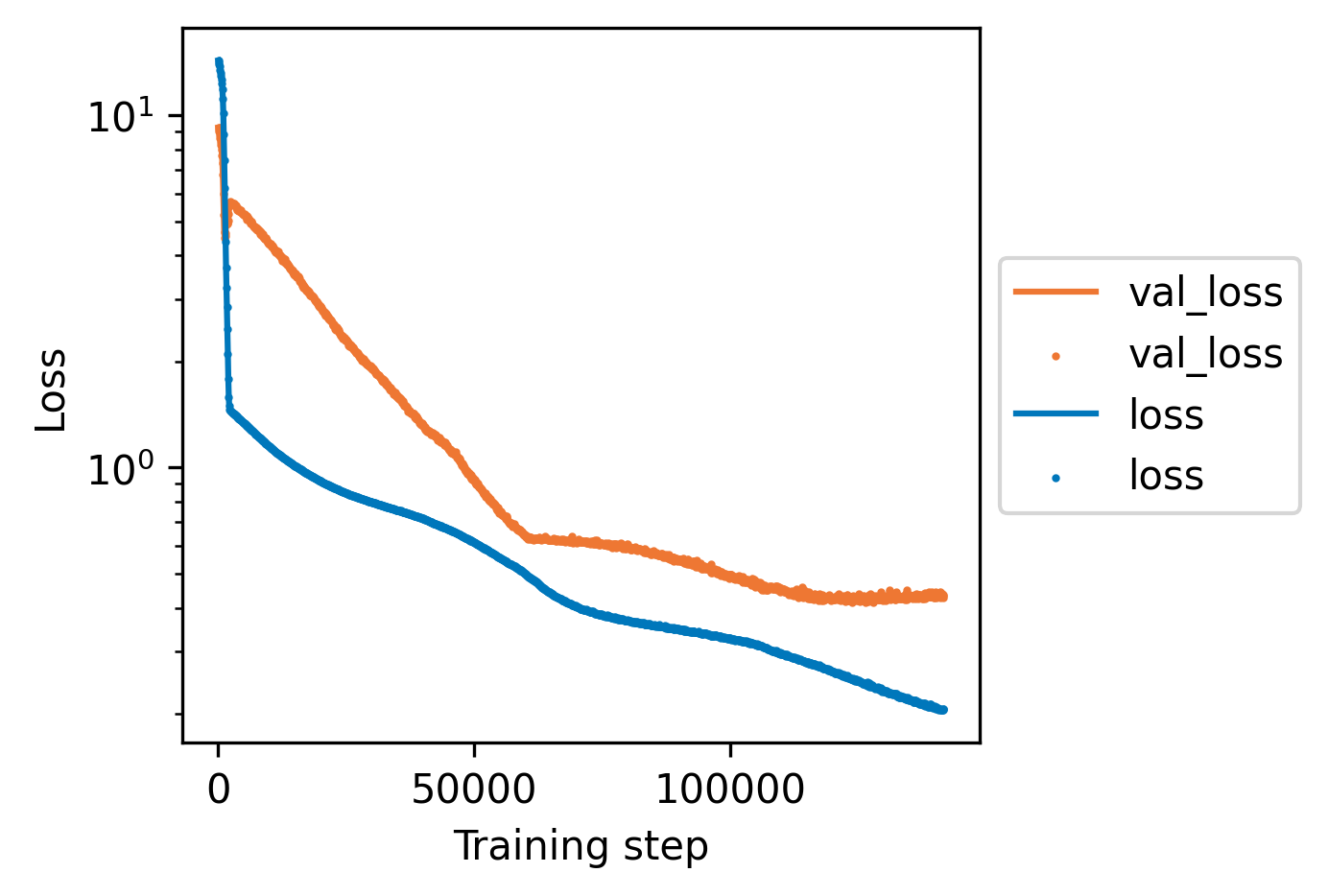 And these are the evaluation scores.
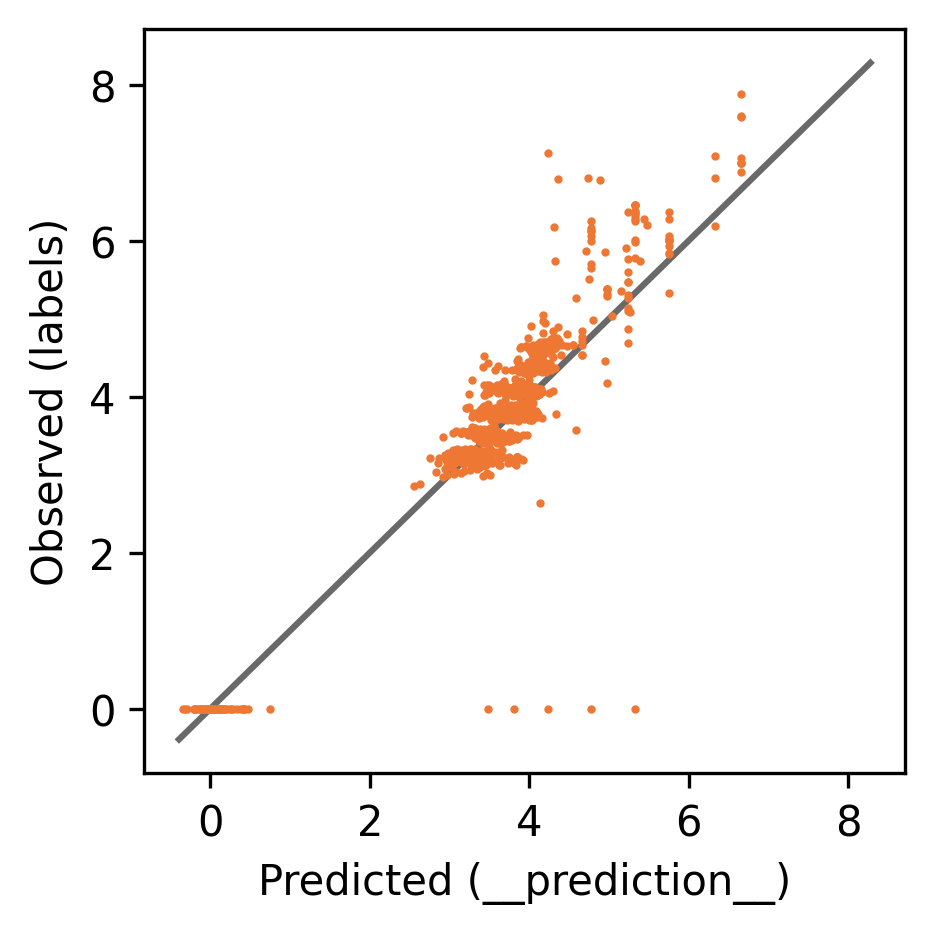
Train (1424 rows):
```json
{
"Pearson r": 0.9141987685996613,
"RMSE": 0.238382488489151,
"Spearman rho": 0.8198319253295027
}
```
And these are the evaluation scores.
Train (1424 rows):
```json
{
"Pearson r": 0.9141987685996613,
"RMSE": 0.238382488489151,
"Spearman rho": 0.8198319253295027
}
```
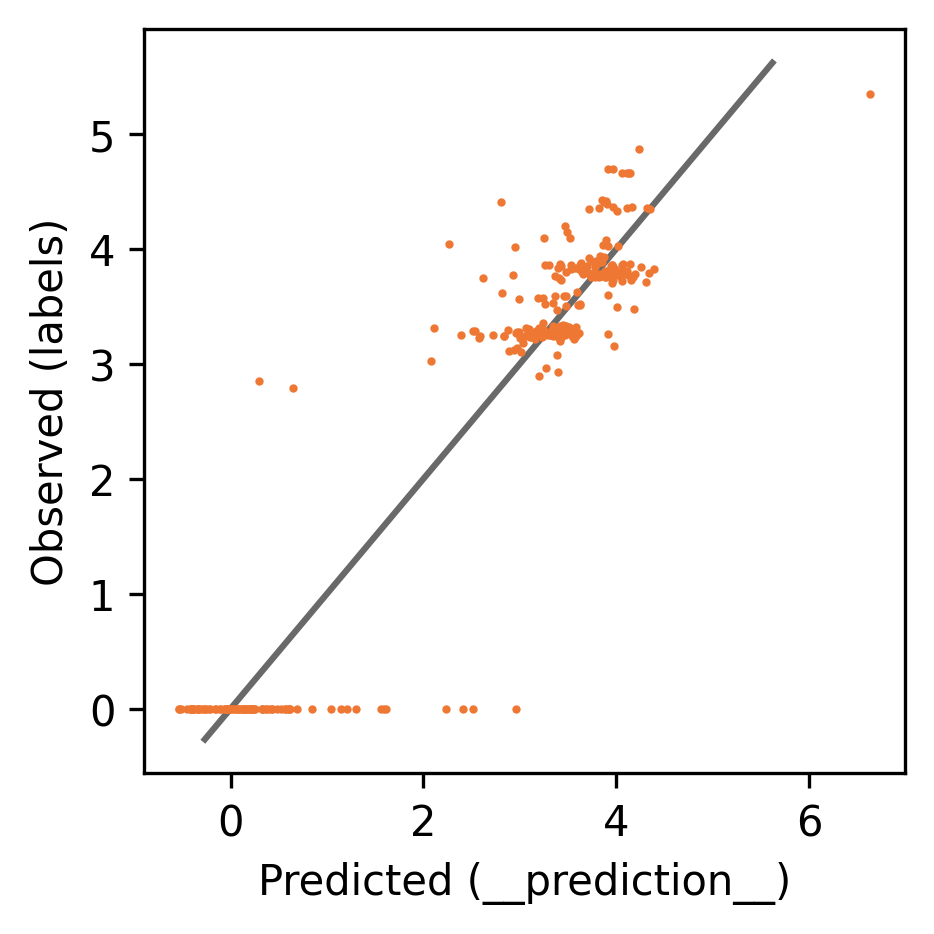
 Validation (309 rows):
```json
{
"Pearson r": 0.9432814998253994,
"RMSE": 0.3496144711971283,
"Spearman rho": 0.8553478966171193
}
```
Validation (309 rows):
```json
{
"Pearson r": 0.9432814998253994,
"RMSE": 0.3496144711971283,
"Spearman rho": 0.8553478966171193
}
```
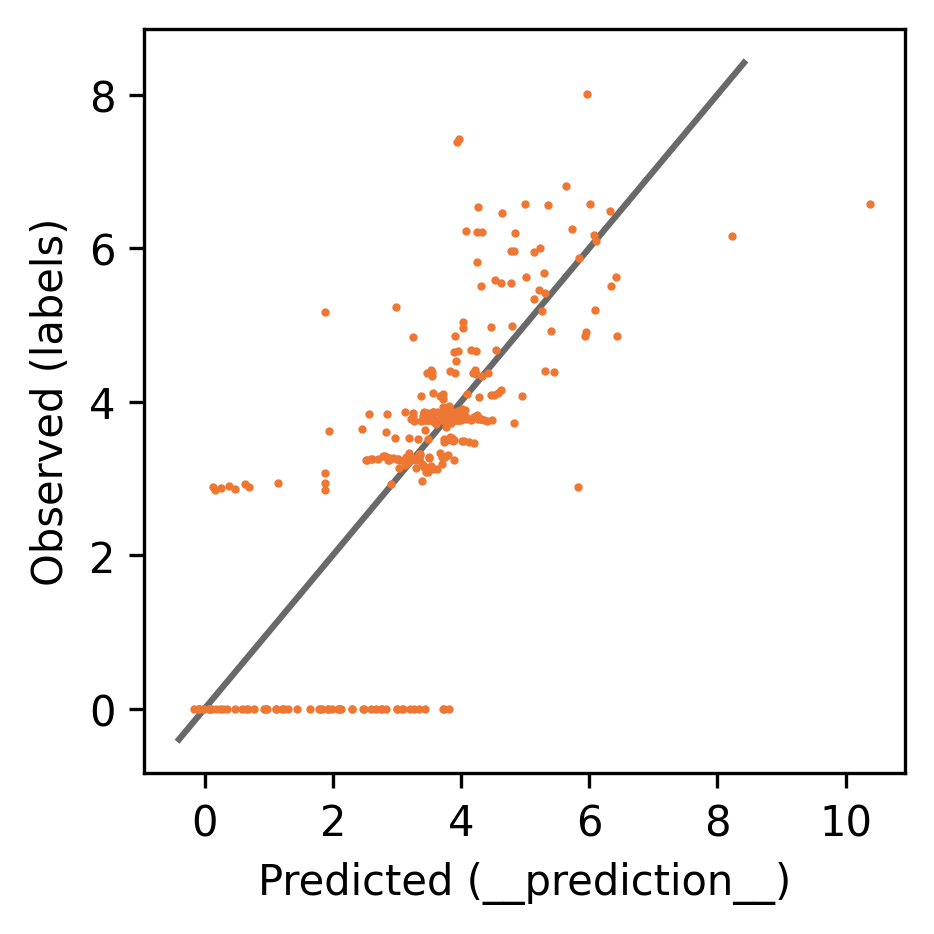
 Test (316 rows):
```json
{
"Pearson r": 0.7588797018977873,
"RMSE": 0.7793745398521423,
"Spearman rho": 0.8158068476381244
}
```
Test (316 rows):
```json
{
"Pearson r": 0.7588797018977873,
"RMSE": 0.7793745398521423,
"Spearman rho": 0.8158068476381244
}
```
 ## Training data details
The training data were collated by the authors of:
> Joe Thomas, Marc Navre, Aileen Rubio, and Allan Coukell
> Shared Platform for Antibiotic Research and Knowledge: A Collaborative Tool to SPARK Antibiotic Discovery
> ACS Infectious Diseases 2018 4 (11), 1536-1539
> DOI: 10.1021/acsinfecdis.8b00193
We cleaned the original SPARK dataset to subset the most relevant columns, remove empty values,
give succint column titles, and split by species.
This particular dataset retains only measurements on bacteria with wild-type accumulation phenotypes.
### Dataset Sources
- **Repository:** https://www.collaborativedrug.com/spark-data-downloads
- **Paper:** https://doi.org/10.1021/acsinfecdis.8b00193
### Data Collection and Processing
Data were processed using [schemist](https://github.com/scbirlab/schemist), a tool for processing chemical datasets.
The SMILES strings have been canonicalized, and split into training (70%), validation (15%), and test (15%) sets
by Murcko scaffold for each species with more than 1000 entries. Additional features like molecular weight and
topological polar surface area have also been calculated.
### Who are the source data producers?
Joe Thomas, Marc Navre, Aileen Rubio, and Allan Coukell
## Training data details
The training data were collated by the authors of:
> Joe Thomas, Marc Navre, Aileen Rubio, and Allan Coukell
> Shared Platform for Antibiotic Research and Knowledge: A Collaborative Tool to SPARK Antibiotic Discovery
> ACS Infectious Diseases 2018 4 (11), 1536-1539
> DOI: 10.1021/acsinfecdis.8b00193
We cleaned the original SPARK dataset to subset the most relevant columns, remove empty values,
give succint column titles, and split by species.
This particular dataset retains only measurements on bacteria with wild-type accumulation phenotypes.
### Dataset Sources
- **Repository:** https://www.collaborativedrug.com/spark-data-downloads
- **Paper:** https://doi.org/10.1021/acsinfecdis.8b00193
### Data Collection and Processing
Data were processed using [schemist](https://github.com/scbirlab/schemist), a tool for processing chemical datasets.
The SMILES strings have been canonicalized, and split into training (70%), validation (15%), and test (15%) sets
by Murcko scaffold for each species with more than 1000 entries. Additional features like molecular weight and
topological polar surface area have also been calculated.
### Who are the source data producers?
Joe Thomas, Marc Navre, Aileen Rubio, and Allan Coukell