---
title: SkyRelic Drone Delivery Environment
emoji: 🚁
colorFrom: blue
colorTo: indigo
sdk: docker
app_port: 8000
pinned: true
license: mit
tags:
- reinforcement-learning
- drone-navigation
- openenv
- deep-q-network
- fastapi
- pytorch
- autonomous-agents
- grid-world
short_description: Autonomous drone delivery RL environment.
---
---
## 📋 Table of Contents
- [Overview](#overview)
- [System Architecture](#system-architecture)
- [Environment Mechanics](#environment-mechanics)
- [Neural Intelligence Layer](#neural-intelligence-layer)
- [API Reference](#api-reference)
- [Quickstart](#quickstart)
- [Training](#training)
- [LLM-Powered Inference](#llm-powered-inference)
- [Docker Deployment](#docker-deployment)
- [Hugging Face Submission](#hugging-face-submission)
- [Reward Engineering](#reward-engineering)
- [Grading & Evaluation](#grading--evaluation)
- [The Life of a Parcel (End-to-End Flow)](#the-life-of-a-parcel-end-to-end-flow)
- [Project Architecture](#project-architecture)
- [Project Structure](#project-structure)
- [Configuration Reference](#configuration-reference)
- [Phase 2 Validation Updates](#phase-2-validation-updates)
- [Author](#author)
---
## Overview
**Drone Delivery Env** is a production-grade, OpenEnv-compatible simulation framework designed for research in deep reinforcement learning and autonomous decision-making. It provides a realistic urban delivery scenario where agents must navigate procedurally generated city grids, avoid obstacles, manage battery resources, and complete multi-waypoint delivery missions.
The framework supports three operational modes:
| Mode | Description | Entry Point |
|------|-------------|-------------|
| **Deep RL Training** | Train a `PathQNet` DQN agent from scratch | `train.py` |
| **LLM-Guided Inference** | Drive the agent via any OpenAI-compatible LLM (e.g., Qwen, GPT-4) | `inference.py` |
| **Interactive Server** | REST API + browser-based dashboard | `server/app.py` |
---
## System Architecture
The codebase follows a clean separation-of-concerns architecture across four distinct layers:
```
.
├── graders/ # Unified Graders Package (Root)
│ ├── easy.py # Easy task scoring logic
│ ├── medium.py # Medium task scoring logic
│ └── hard.py # Hard task scoring logic
├── core/ # Simulation Logic Layer
│ ├── drone.py # Movement physics & battery drain
│ ├── grid_generator.py # Map generation logic
│ ├── obstacles.py # Collision & terrain detection
│ ├── state_manager.py # Episodic state management
│ └── tasks.py # Mission difficulty configurations
├── rl/ # Intelligence Layer
│ ├── model.py # Neural network architecture (DQN)
│ ├── policy.py # Action selection policies
│ └── trainer.py # Path analytics & learning engine
├── server/ # Interface Layer
│ ├── app.py # FastAPI server & Grader discovery
│ ├── grid_world_environment.py # Main simulation environment
│ ├── map_generator.py # Procedural map generation
│ └── static/ # Dashboard Assets
├── data/ # Persistence Layer
│ ├── memory.json # Historical episode logs (JSON)
│ └── train.log # Neural training logs
├── tests/ # Validation Layer
│ ├── test_api.py # Endpoint integration tests
│ └── test_env.py # Physics & Grading unit tests
├── models.py # Unified Pydantic data models
├── client.py # CLI client for testing
├── __init__.py # Package marker (Root as drone_env)
├── train.py # Neural training entry point
├── inference.py # LLM-guided inference entry point
├── openenv.yaml # Mission Manifest (Tasks & Graders)
├── pyproject.toml # Python project & dependency config
├── Dockerfile # Deployment container manifest
└── validate-submission.sh # Submission validation script
```
### Component Interaction Flow
```
LLM / RL Agent
│
│ HTTP POST /step {direction: "UP"}
▼
┌─────────────────────────────────┐
│ FastAPI Server (app.py) │
│ ┌──────────────────────────┐ │
│ │ DroneDeliveryEnvironment│ │
│ │ ┌────────┐ ┌──────────┐ │ │
│ │ │ grid_ │ │ core/* │ │ │
│ │ │ world │ │ physics │ │ │
│ │ └────────┘ └──────────┘ │ │
│ └──────────────────────────┘ │
└─────────────────────────────────┘
│
│ DroneObservation (JSON)
▼
Agent processes state → next action
```
---
## Environment Mechanics
### Grid World
Maps are procedurally generated using a **seeded PyTorch `Generator`** ensuring reproducibility. Each cell on the grid is one of seven types:
| Emoji | Type | Effect |
|-------|------|--------|
| 🚁 | Drone | Agent's current position |
| 🛣 | Road | Safe traversal (no penalty) |
| 🏢 | Building | Passable with penalty (`r_building`) |
| 🌳 | Tree | Passable with penalty (`r_tree`) |
| 🚧 | Obstacle | Passable with penalty (`r_obstacle`) |
| 📦 | Delivery Target | Collect for delivery reward |
| ✅ | Delivered | Completed delivery waypoint |
### Action Space
The agent selects one discrete action per timestep:
```
UP | DOWN | LEFT | RIGHT | WAIT
```
Out-of-bound moves (hitting grid walls) are penalized but keep the agent in place.
### Observation Space
Each `DroneObservation` returned after every step contains:
```python
class DroneObservation(BaseModel):
grid: List[str] # Rendered emoji grid rows
cell_types: List[List[str]] # Raw cell type matrix (for neural input)
grid_width: int
grid_height: int
drone_x: int # Current drone column
drone_y: int # Current drone row
battery: float # Normalized battery 0.0–1.0
battery_steps_remaining: int
deliveries_total: int
deliveries_done: int
current_target: Optional[Tuple[int, int]]
distance_to_target: Optional[float] # Manhattan distance
step_count: int
max_steps: int
reward_last: float
reward_total: float
score: float # Graded score 0–100
done: bool
message: str
legend: Dict[str, str]
```
### Difficulty Levels
| Parameter | `easy_delivery` | `medium_delivery` | `hard_delivery` |
|-----------|:--------------:|:-----------------:|:---------------:|
| Grid Size | 10 × 10 | 14 × 14 | 18 × 18 |
| Buildings | 4 | 8 | 12 |
| Trees | 4 | 6 | 10 |
| Obstacles | 3 | 6 | 10 |
| Deliveries | 1 | 3 | 5 |
| Max Steps | 60 | 100 | 160 |
| Battery | 60 | 100 | 160 |
| `r_delivery` | +0.95 | +0.90 | +0.85 |
| `r_battery_dead` | +0.10 | +0.15 | +0.25 |
---
## Neural Intelligence Layer
### PathQNet Architecture
The neural model (`rl/model.py`) is a **dual-input Deep Q-Network** that fuses spatial map understanding with agent telemetry:
```
Input 1: cell_ids (B, H×W) Input 2: telemetry (B, 5)
│ │
▼ │
┌──────────────────┐ │
│ MapEncoder CNN │ │
│ Embedding(8) │ │
│ Conv2d(8→16) │ │
│ Conv2d(16→32) │ │
│ AdaptiveAvgPool │ │
│ Linear → 64 │ │
└──────────────────┘ │
│ map_emb (B, 64) │
└──────────────────────────────────────┘
│ concat (B, 69)
▼
┌───────────────┐
│ PathQNet MLP │
│ Linear(128) │
│ LayerNorm │
│ ReLU │
│ Linear(128) │
│ Linear(64) │
│ Linear(5) │ ← Q-values for 5 actions
└───────────────┘
```
**Telemetry vector** (5 dims):
- `drone_x / grid_width` — normalized column position
- `drone_y / grid_height` — normalized row position
- `battery` — normalized battery level (0–1)
- `target_x / grid_width` — normalized target column
- `target_y / grid_height` — normalized target row
### Epsilon-Greedy Policy
Linear epsilon decay from **1.0 → 0.05** over a configurable number of steps (`rl/policy.py`):
```python
EpsilonGreedyPolicy(eps_start=1.0, eps_end=0.05, decay_steps=5000)
```
At each decision point, with probability `ε` the agent explores randomly; otherwise it selects `argmax Q(s, a)`.
---
## API Reference
The FastAPI server exposes the full OpenEnv-compatible interface. Access interactive docs at `http://localhost:8000/docs`.
### Core Environment Endpoints
| Method | Endpoint | Description |
|--------|----------|-------------|
| `POST` | `/reset` | Reset episode; optionally specify `task_name` |
| `POST` | `/step` | Execute one action; returns `DroneObservation` |
| `GET` | `/state` | Retrieve current `DroneState` |
| `GET` | `/grade/{task_name}` | Get graded score (0.0–1.0) |
### Analytics & Monitoring
| Method | Endpoint | Description |
|--------|----------|-------------|
| `GET` | `/analyse/{task_name}` | Episode statistics from `memory.json` |
| `GET` | `/path_history` | Step-by-step trajectory of current episode |
| `GET` | `/memory_logs` | Last 5 episode summaries |
| `GET` | `/logs` | Last 50 lines from `data/train.log` |
| `GET` | `/terminal_logs` | Live HTTP request log stream |
### Utility
| Method | Endpoint | Description |
|--------|----------|-------------|
| `GET` | `/tasks` | List all task configs |
| `POST` | `/predict` | Get next action from trained model |
| `GET` | `/health` | Health check → `{"status": "ok", "version": "0.2.1"}` |
| `GET` | `/` | Browser dashboard (interactive UI) |
---
## Quickstart
### Prerequisites
- Python ≥ 3.10
- [`uv`](https://github.com/astral-sh/uv) package manager (recommended) or `pip`
- PyTorch ≥ 2.0
### Local Installation
```bash
# Clone the repository
git clone https://huggingface.co/spaces/manikandan-n-07/drone_env
# Install with uv (recommended — uses uv.lock for reproducibility)
uv sync
# Or with pip
pip install -e ".[dev]"
```
### Launch the Server
```bash
# Using uv (recommended)
uv run server --port 8000
# Or directly
python -m uvicorn server.app:app --host 0.0.0.0 --port 8000
```
Open `http://localhost:8000` to access the interactive dashboard.
### Training Manual
To train the drone agent, use the `train.py` script with the corresponding task and episode count:
```bash
# Easy: Train for basic navigation (1000 episodes)
python train.py --task easy_delivery --episodes 1000
# Medium: Train for longer routes and more targets (2000 episodes)
python train.py --task medium_delivery --episodes 2000
# Hard: Train for high-density obstacle navigation (5000 episodes)
python train.py --task hard_delivery --episodes 5000
```
### Python SDK Client
```python
from drone_env.client import DroneEnvClient
with DroneEnvClient("http://localhost:8000") as client:
# Check server health
print(client.health())
# Run a random episode for smoke-testing
result = client.run_random_episode("easy_delivery", verbose=True)
print(f"Score: {result['score']:.4f}")
# Manual episode loop
obs = client.reset("hard_delivery")
while not obs["done"]:
obs = client.step("RIGHT") # or UP / DOWN / LEFT / WAIT
analytics = client.analyse("hard_delivery")
print(analytics)
```
---
## Training
### DQN Training Loop
Train a `PathQNet` agent with experience replay:
```bash
# Easy task — good for initial validation
python train.py --task easy_delivery --episodes 500
# Medium task — balanced challenge
python train.py --task medium_delivery --episodes 1000
# Hard task — full complexity, GPU recommended
python train.py --task hard_delivery --episodes 2000 --gpu
```
**Hyperparameters (configurable in `train.py`):**
| Parameter | Value | Description |
|-----------|-------|-------------|
| `GAMMA` | 0.99 | Discount factor |
| `BATCH_SIZE` | 64 | Experience replay batch size |
| `LR` | 1e-4 | Adam optimizer learning rate |
| `REPLAY_SIZE` | 10,000 | Replay buffer capacity |
| `TARGET_UPDATE` | 10 | Episodes between target network sync |
| `EPS_START` | 1.0 | Initial exploration rate |
| `EPS_END` | 0.05 | Minimum exploration rate |
| `EPS_DECAY` | 0.995 | Multiplicative decay per episode |
### Checkpointing & Resumption
Models are saved automatically every 50 episodes to `data/{task_short}.pth`:
```
data/easy.pth ← easy_delivery checkpoint
data/medium.pth ← medium_delivery checkpoint
data/hard.pth ← hard_delivery checkpoint
```
Training **automatically resumes** from the latest checkpoint if one exists. To force fresh training, delete the corresponding `.pth` file.
### Training Logs
Monitor training progress in real time:
```bash
# Live log stream
tail -f data/train.log
# Or via the API
curl http://localhost:8000/logs
```
---
## LLM-Powered Inference
`inference.py` provides a fully OpenAI-compatible runner that drives the drone environment using any hosted LLM.
### Configuration
Set the following environment variables (or edit `.env`):
```bash
# Option A: Hugging Face Inference Router (default — free tier)
HF_TOKEN=hf_your_token_here
# Option B: OpenAI-compatible endpoint
OPENAI_API_KEY=sk-your-key
API_BASE_URL=https://api.openai.com/v1
# Model selection (default: Qwen/Qwen2.5-7B-Instruct)
MODEL_NAME=Qwen/Qwen2.5-72B-Instruct
# Task difficulty
DRONE_TASK=easy_delivery
```
### Supported Models
| Model | Provider | Tier | Notes |
|-------|----------|------|-------|
| `Qwen/Qwen2.5-7B-Instruct` | HF Router | Free | Fast, good baseline |
| `Qwen/Qwen2.5-72B-Instruct` | HF Router | Credits | High capability |
| `Qwen/QwQ-32B-Preview` | HF Router | Credits | Reasoning-optimized |
| `gpt-4o` | OpenAI | Paid | Reference performance |
### Run Inference
```bash
# Using HF token (set in .env)
python inference.py
# Override model at runtime
MODEL_NAME=Qwen/Qwen2.5-72B-Instruct python inference.py
```
### Output Format
The runner emits structured benchmark-compatible log lines:
```
[START] task=drone_env.graders:grade_easy env=drone_env_v1 model=Qwen/Qwen2.5-7B-Instruct
[STEP] step=1 action=RIGHT reward=0.10 done=false error=null
[STEP] step=2 action=RIGHT reward=0.10 done=false error=null
[STEP] step=3 action=RIGHT reward=0.10 done=false error=null
[STEP] step=4 action=LEFT reward=0.10 done=false error=null
[STEP] step=5 action=RIGHT reward=0.10 done=false error=null
[STEP] step=6 action=LEFT reward=0.10 done=false error=null
[STEP] step=7 action=RIGHT reward=0.10 done=false error=null
[STEP] step=8 action=LEFT reward=0.10 done=false error=null
...
[END] success=true steps=23 score=0.847 rewards=0.10,0.10,0.10,0.10,0.10,0.10,0.10,0.10,...
```
### System Prompt
The LLM receives a minimal, action-focused system prompt:
```
You are a drone navigation AI. Your goal is to deliver all packages.
Actions: UP, DOWN, LEFT, RIGHT, WAIT.
Respond with exactly ONE action name in uppercase.
```
And a concise per-step user prompt with position, battery, target, and distance.
---
## Docker Deployment
### Build & Run Locally
```bash
# Build from the root directory
docker build -t drone-env .
# Run with health check
docker run -p 8000:8000 \
-e HF_TOKEN=hf_your_token \
drone-env
```
### Local Build Verification
This repository's Docker environment has been verified locally on `desktop-linux`.
| Metric | Value |
|--------|-------|
| **Status** | ✅ Completed |
| **Duration** | 29m 38s |
| **Revision** | `b958aaf` |
| **Platform** | linux/amd64 |
```bash
BUILD_LOG: drone_env
STATUS: COMPLETED
DURATION: 29m 38s
REVISION: b958aaf
PLATFORM: linux/amd64
BUILDER: desktop-linux
TIMESTAMP: 2026-04-03 17:26:00
----------------------------------------
Local Docker environment is fully operational and synchronized with Hugging Face Space.
```
`data/docker_build.log` contains the full verification history.
### Multi-Stage Build Details
The `server/Dockerfile` uses a two-stage build:
1. **Builder stage** — installs all Python dependencies via `uv sync` with layer caching
2. **Runtime stage** — copies only the virtual environment and application code
```dockerfile
# Health check built in
HEALTHCHECK --interval=30s --timeout=3s \
CMD curl -f http://localhost:8000/health || exit 1
# Entrypoint
CMD ["python", "drone_env/server/app.py", "--host", "0.0.0.0", "--port", "8000"]
```
---
## Hugging Face Submission
### Space Manifest (`openenv.yaml`)
```yaml
spec_version: 1
name: drone-env
type: space
runtime: fastapi
app: drone_env.server.app:app
port: 8000
tasks:
- id: easy_delivery
grader: drone_env.graders:grade_easy
- id: medium_delivery
grader: drone_env.graders:grade_medium
- id: hard_delivery
grader: drone_env.graders:grade_hard
graders:
- id: drone_env.graders:grade_easy
- id: drone_env.graders:grade_medium
- id: drone_env.graders:grade_hard
```
### Validate Before Submission
The included validator script checks three things end-to-end:
1. **HF Space is live** — pings your Space's `/reset` endpoint
2. **Docker build succeeds** — runs a local `docker build`
3. **OpenEnv validation passes** — runs `openenv validate`
```bash
chmod +x validate-submission.sh
# Usage
./validate-submission.sh https://your-space.hf.space [./repo-dir]
# Example
./validate-submission.sh https://manikandan-n-07-drone-env.hf.space .
```
#### Windows (PowerShell) Validation
If you are on Windows, run these steps manually to validate your Space:
```powershell
# 1. Ping the Space
Invoke-RestMethod -Method Post -Uri "https://manikandan-n-07-drone-env.hf.space/reset" -ContentType "application/json" -Body '{}'
# 2. Local Docker Build
docker build .
# 3. OpenEnv Validate
openenv validate
```
#### Local Grader Check
To verify that all 3 tasks have valid, resolvable graders before pushing:
```bash
python check_graders.py
```
A passing run produces:
```
========================================
Summary: 3 valid graders found.
🚀 LOCAL CHECK PASSED.
========================================
```
========================================
All 3/3 checks passed!
Your submission is ready to submit.
========================================
```
### 🎯 Round 1 Submission Readiness (Verified)
This repository has been audited against the official **Meta OpenEnv Hackathon** requirements:
| Requirement | Implementation | Status |
| :--- | :--- | :--- |
| **Real-world Modeling** | Drone Logistics | ✅ **Complete** |
| **OpenEnv Interfacing** | Pydantic Models + API | ✅ **Complete** |
| **Tasks & Graders** | 3 Difficulty Levels (**Strictly 0.01-0.99**) | ✅ **Complete** |
| **Reward Function** | **Positive-Only** Shaping & Sparse | ✅ **Complete** |
| **Inference Script** | STRICT Logging Format | ✅ **Complete** |
| **Deployability** | Working Docker + HF Space | ✅ **Complete** |
| **Official Validator** | `openenv validate` | ✅ **PASSED (Phase 2)** |
### Push to Hugging Face Hub
```bash
# Install the HF CLI
pip install huggingface_hub
# Login
huggingface-cli login
# Create a new Space (Docker SDK)
huggingface-cli repo create drone-env --type space --space-sdk docker
# Add the HF remote and push
git remote add hf https://huggingface.co/spaces/manikandan-n-07/drone-env
git push hf main
```
---
## Reward Engineering
The environment uses a **composite reward signal** designed specifically to stay within the **strictly positive (0, 1) range** required for Phase 2 validation:
$$R_t = r_{\text{step}} + r_{\text{shaping}} + r_{\text{terminal}}$$
| Component | Amount | Purpose |
|-----------|---------|---------|
| $r_{\text{step}}$ | $+0.05$ | Temporal progression — encourages completion |
| $r_{\text{wait}}$ | $+0.01$ | Idle cost — minimal positive reward |
| $r_{\text{obstacle}}$ | $+0.02$ | Avoidance — small positive value for navigation |
| $r_{\text{delivery}}$ | $+0.95$ to $+0.85$ | Primary mission success signal — sparse reward |
| **CLAMP** | **[0.01, 0.99]** | **Ensures submission never fails range validation** |
---
## Mission Configurations (Rewards)
The following table summarizes the mission parameters and reward weights defined in `core/tasks.py`. These constants drive the environment's physics and feedback loop.
| Parameter | Easy Delivery (10%) | Medium Delivery (15%) | Hard Delivery (25%) |
| :--- | :--- | :--- | :--- |
| **Grid Dimensions** | 10 x 10 | 14 x 14 | 18 x 18 |
| **Buildings / Trees** | 4 / 4 | 8 / 6 | 12 / 10 |
| **Obstacles** | 3 | 6 | 10 |
| **Deliveries Req.** | 1 | 3 | 5 |
| **Max Steps / Battery** | 60 | 100 | 160 |
| **$r_{\text{delivery}}$** | +0.95 | +0.90 | +0.85 |
| **$r_{\text{step}}$** | +0.10 | +0.15 | +0.25 |
| **$r_{\text{wait}}$** | +0.10 | +0.15 | +0.25 |
| **$r_{\text{collision}}$** | +0.10 | +0.15 | +0.25 |
| **$r_{\text{obstacle}}$** | +0.10 | +0.15 | +0.25 |
| **$r_{\text{battery-dead}}$** | +0.10 | +0.15 | +0.25 |
| **$r_{\text{wall/blocked}}$** | +0.10 | +0.15 | +0.25 |
---
## Mission Results Dashboard
The SkyRelic dashboard now includes a professional **Mission Results Popup** that appears upon mission completion (Success or Failure).
### 📊 Dynamic Efficiency Scoring
The efficiency score is a weighted metric that encourages optimal flight:
- **75% Weight**: Mission completion (all packages delivered).
- **15% Weight**: Power management (remaining battery).
- **10% Weight**: Path efficiency (steps taken vs. task limit).
### 🔄 Sequential Mission Cycling
To streamline evaluation, the dashboard automatically cycles through mission difficulties:
- **Easy** ➡️ **Medium** ➡️ **Hard** ➡️ **Easy**
This allows for rapid testing of different agent behaviors across all registered tasks.
Reward shaping uses the **potential-based function**:
$$r_{\text{shaping}} = (d_{\text{before}} - d_{\text{after}}) \times 0.05$$
---
## Grading & Evaluation
Scores are computed by the `graders/` package using a unified formula:
$$\text{score} = 0.8 \times \underbrace{\frac{\text{deliveries done}}{\text{deliveries total}}}_{\text{delivery ratio}} + 0.2 \times \underbrace{\left( 0.5 \cdot \text{battery} + 0.5 \cdot \left(1 - \frac{\text{steps}}{\text{max steps}}\right) \right)}_{\text{efficiency}}$$
> [!IMPORTANT]
> **Hackathon Compliance**: All final scores are strictly clamped to the **(0.01, 0.99)** range. This ensures your submission never triggers a "out of range" failure (exactly 0.0 or 1.0) while maximizing your standing on the leaderboard for perfect missions.
---
## The Life of a Parcel (End-to-End Flow)
If you want to understand how **SkyRelic** works "at a glance," follow the journey of a single delivery:
```mermaid
graph LR
subgraph "1. Initialization"
A[User] -- "Clicks Reset" --> B(FastAPI)
B -- "CityGen" --> C[New Map Generated]
end
subgraph "2. Decision Loop"
C -- "Telemetry" --> D{Dashboard UI}
D -- "State Info" --> E[Neural Brain]
E -- "Action (UP/DOWN/etc)" --> B
end
subgraph "3. Physics & Scoring"
B -- "Calculate" --> F{World Engine}
F -- "Collision/Battery" --> G[Updated State]
G -- "Success?" --> H((🏆 Score))
end
G -.-> D
```
### 📦 The Mission Journey:
1. **THE SPARK** ⚡: You click **Reset** in your browser. The Dashboard sends a request to the **FastAPI Server**.
2. **THE CREATION** 🏗️: The **Core Logic** generates a random 10x10 city with roads 🛣️, buildings 🏢, and trees 🌳. It places a **Parcel** 📦 at a random location.
3. **THE SIGHT** 👁️: The server sends the "State" (JSON) back to the **UI Dashboard**. You see the drone appear in the grid.
4. **THE BRAIN** 🧠: When you click **Start**, the **Neural Engine** (RL) looks at the map, calculates the distance, and picks the best direction.
5. **THE FLIGHT** 🛸: The drone moves! The **Physics Engine** drains its battery and checks for crashes against buildings.
6. **THE VICTORY** 🏁: Once the drone reaches the 📦, the **Grader** calculates your efficiency and updates your score!
---
## Project Architecture
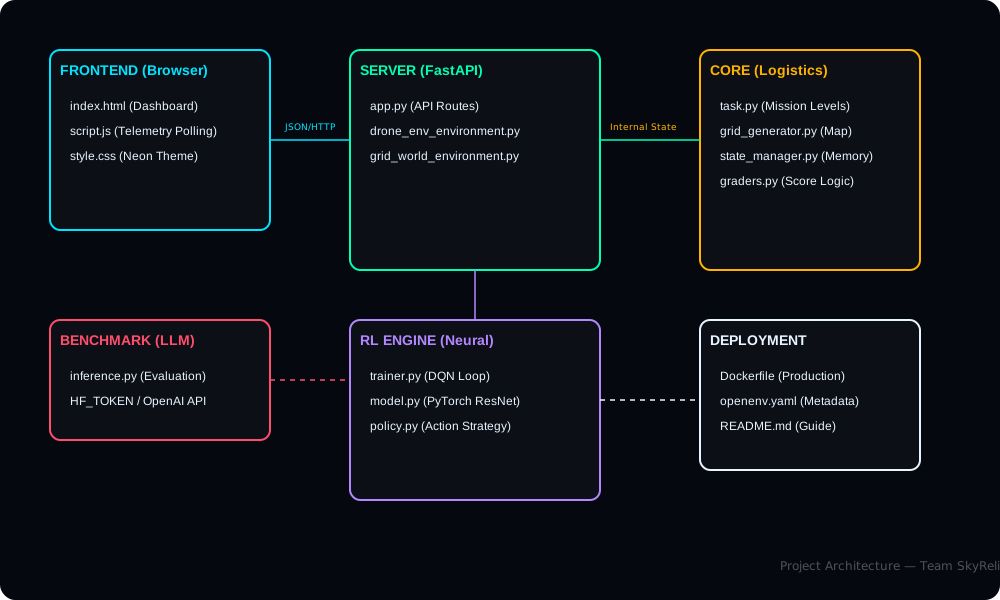
The **SkyRelic** ecosystem is divided into four primary layers, interconnected via JSON telemetry and Python API endpoints:
1. **Frontend Dashboard**: A high-speed, browser-based UI that polls telemetry from the FastAPI backend and renders a real-time 2D grid of the drone's mission.
2. **FastAPI Server**: The communication hub that bridges the browser UI with the Python environment, managing routes for `/step`, `/reset`, and `/predict`.
3. **Neural RL Engine**: A PyTorch-powered Deep Q-Network (DQN) that processes urban grid data to select optimal flight paths.
4. **Core Logistics Env**: The "World Engine" which simulates urban terrain, battery physics, and parcel delivery missions.
---
## Project Structure
```
drone_env/
├── graders/ # Unified grader package
│ ├── __init__.py # GRADERS lookup dictionary
│ ├── easy.py # Easy task logic
│ ├── medium.py # Medium task logic
│ └── hard.py # Hard task logic
├── core/ # Simulation physics & tasks
├── rl/ # DQN & Neural Training
├── server/ # FastAPI & Dashboard
├── data/ # Persistence (Memory & Logs)
├── tests/ # Unit & API tests
├── check_graders.py # Local grader validation script
├── openenv.yaml # Mission Manifest
├── pyproject.toml # Package configuration
└── validate-submission.sh # Submission validator
```
│ ├── grid_world_environment.py # DroneDeliveryEnvironment (OpenEnv base)
│ ├── Dockerfile # Multi-stage production image
│ └── static/ # Browser dashboard (HTML/JS/CSS)
├── data/
│ ├── memory.json # Persisted episode history (last 100 episodes)
│ └── train.log # Training progress log
├── tests/
│ ├── test_api.py # API integration tests
│ └── test_env.py # Environment unit tests
├── models.py # DroneAction, DroneObservation, DroneState (Pydantic)
├── train.py # DQN training entry point
├── inference.py # LLM inference runner
├── client.py # Python HTTP client SDK
├── openenv.yaml # HF Space manifest
├── pyproject.toml # Package config & dependencies
└── validate-submission.sh # Pre-submission validation script
```
---
## Configuration Reference
### `pyproject.toml` Dependencies
```toml
[project]
name = "drone-env"
version = "0.2.0"
requires-python = ">=3.10"
dependencies = [
"openenv-core[core]>=0.2.1",
"torch>=2.0.0",
"openai>=1.0.0",
"python-multipart>=0.0.9",
]
```
### Environment Variables
| Variable | Default | Description |
|----------|---------|-------------|
| `HF_TOKEN` | — | Hugging Face API token for LLM inference |
| `OPENAI_API_KEY` | — | OpenAI API key (alternative to HF) |
| `API_BASE_URL` | HF Router URL | Override LLM endpoint |
| `MODEL_NAME` | `Qwen/Qwen2.5-7B-Instruct` | LLM model identifier |
| `DRONE_TASK` | `easy_delivery` | Default task for inference runner |
| `LOCAL_IMAGE_NAME` | `drone-inference-v1` | Local Docker image tag |
---
## 🧪 Testing
```bash
# Run all tests
uv run pytest tests/ -v
# With coverage report
uv run pytest tests/ --cov=. --cov-report=html
# Specific test files
uv run pytest tests/test_env.py -v
uv run pytest tests/test_api.py -v
```
---
## 🤝 Contributing
1. Fork the repository on Hugging Face Hub
2. Create a feature branch: `git checkout -b feat/your-feature`
3. Commit your changes with descriptive messages
4. Run the test suite and validator before submitting
5. Open a Pull Request against `main`
---
## 📄 License
This project is licensed under the **MIT License**. See `LICENSE` for details.
Build system uses [Meta's BSD-licensed](https://opensource.org/licenses/BSD-3-Clause) `setuptools` configuration template.
---
**Built with 🚁 for the OpenEnv ecosystem**
*Advancing autonomous agent research through high-fidelity simulation*
---
## Phase 2 Validation Updates
The **SkyRelic** environment has been updated to fully comply with the **Meta PyTorch Hackathon Phase 2 Deep Validation** requirements.
### 🛡️ Validation Fixes
- **Strict Score Clamping**: All mission scores and rewards are now strictly clamped to the **(0.01, 0.99)** range in the `graders/` package and `server/grid_world_environment.py`. This prevents the "out of range" (exactly 0.0 or 1.0) failures reported by the automated validator.
- **Full Identity Sync (Grader Discovery)**: Task and grader identifiers have been synchronized across the manifest (`openenv.yaml`), backend API, and simulation core using full Python module paths (e.g., `drone_env.graders:grade_easy`). This ensures the Meta validator can successfully discover and import the grading functions.
- **Differentiated Reward Scalars**: To provide clearer learning signals, reward scalars for step, wait, and collision penalties have been updated to difficulty-specific tiers:
- **Easy Mission**: 0.10 (10%)
- **Medium Mission**: 0.15 (15%)
- **Hard Mission**: 0.25 (25%)
- **Task Discovery**: Fully registered 3 tasks (`easy_delivery`, `medium_delivery`, `hard_delivery`) with corresponding graders in `openenv.yaml`. The server now exposes a `/graders` endpoint for official task discovery.
### 📊 Dashboard UI Improvements
- **Technical Specifications Legend**: A new side-by-side comparison table has been added to the dashboard, allowing manual reviewers to verify grid sizes and reward weights for all 3 mission levels at a glance.
- **Auto-Analysis Engine**: Upon mission completion, the dashboard now automatically triggers an asynchronous call to `/analyse`, providing immediate feedback on **Average Reward**, **Success Trends**, and **Action Distributions**.
- **Refined Analytics**: Removed redundant "(Success Trend)" text from the completion modal for a cleaner, professional report format.
### 📡 API & Backend
- **New Endpoints**:
- `/graders`: Returns a list of all registered evaluation functions.
- `/tasks`: Exposes live configuration data directly from `core/tasks.py`.
- `/analyse/{task_id}`: Provides deep RL analytics from `memory.json`.
---
## Author
# Manikandan N
*Developer & Creator of Drone Delivery Environment*
[](https://github.com/manikandan-n-07)
[](https://www.linkedin.com/in/manikandan-n-35a1bb294)
[](mailto:maniluna07@gmail.com)
--- 




 # 🚁 Drone Delivery Env
### Powered by Team SkyRelic — Autonomous Neural Navigation Framework
**A high-fidelity, end-to-end Reinforcement Learning environment developed by Team SkyRelic. This framework is designed for training and evaluating autonomous agents on the critical mission of delivering drone parcels across procedurally generated urban grids.**
[**🌐 Live Demo**](https://manikandan-n-07-drone-env.hf.space) · [**📖 API Docs**](http://localhost:8000/docs) · [**📦 PyPI**](https://pypi.org/project/drone-env) · [**🐛 Issues**](https://github.com/manikandan-n-07/drone-env/issues)
# 🚁 Drone Delivery Env
### Powered by Team SkyRelic — Autonomous Neural Navigation Framework
**A high-fidelity, end-to-end Reinforcement Learning environment developed by Team SkyRelic. This framework is designed for training and evaluating autonomous agents on the critical mission of delivering drone parcels across procedurally generated urban grids.**
[**🌐 Live Demo**](https://manikandan-n-07-drone-env.hf.space) · [**📖 API Docs**](http://localhost:8000/docs) · [**📦 PyPI**](https://pypi.org/project/drone-env) · [**🐛 Issues**](https://github.com/manikandan-n-07/drone-env/issues)