
Datasets:

File size: 8,737 Bytes
f683990 b2a3d55 57e6910 f683990 57e6910 b2a3d55 3cce46b b525eac 3cce46b 57e6910 3cce46b bcaa174 3cce46b bd7c6ce 3cce46b b2a3d55 57e6910 b2a3d55 07e7037 57e6910 07e7037 69b072e b2a3d55 b592342 b2a3d55 ea52877 b2a3d55 3cce46b b2a3d55 57e6910 e1529b3 b2a3d55 3cce46b a078585 3cce46b 060aacf 3cce46b 717c37b b2a3d55 3cce46b 67200e3 b2a3d55 9423904 c13ff1a 9423904 c13ff1a 2113638 9423904 b2a3d55 cd962b2 | 1 2 3 4 5 6 7 8 9 10 11 12 13 14 15 16 17 18 19 20 21 22 23 24 25 26 27 28 29 30 31 32 33 34 35 36 37 38 39 40 41 42 43 44 45 46 47 48 49 50 51 52 53 54 55 56 57 58 59 60 61 62 63 64 65 66 67 68 69 70 71 72 73 74 75 76 77 78 79 80 81 82 83 84 85 86 87 88 89 90 91 92 93 94 95 96 97 98 99 100 101 102 103 104 105 106 107 108 109 110 111 112 113 114 115 116 117 118 119 120 121 122 123 124 125 126 127 128 129 130 131 132 133 134 135 136 137 138 139 140 141 142 143 144 145 146 147 148 149 150 151 152 153 154 155 156 157 158 159 160 161 162 163 164 165 166 167 168 169 170 171 172 173 174 175 176 177 178 179 180 181 182 | ---
license: cc-by-nc-nd-4.0
task_categories:
- audio-classification
language:
- zh
- en
tags:
- music
- art
pretty_name: Chinese Traditional Instrument Sound Dataset
size_categories:
- 1K<n<10K
dataset_info:
- config_name: default
features:
- name: audio
dtype:
audio:
sampling_rate: 44100
- name: mel
dtype: image
- name: label
dtype: int16
- name: cname
dtype: string
- name: pinyin
dtype: string
splits:
- name: train
num_bytes: 2337167
num_examples: 4956
download_size: 6640960937
dataset_size: 2337167
- config_name: eval
features:
- name: mel
dtype: image
- name: cqt
dtype: image
- name: chroma
dtype: image
- name: label
dtype: int16
splits:
- name: train
num_bytes: 18475805
num_examples: 34630
- name: validation
num_bytes: 2247162
num_examples: 4212
- name: test
num_bytes: 2247240
num_examples: 4212
download_size: 3443906087
dataset_size: 22970207
configs:
- config_name: default
data_files:
- split: train
path: default/train/data-*.arrow
- config_name: eval
data_files:
- split: train
path: eval/train/data-*.arrow
- split: validation
path: eval/validation/data-*.arrow
- split: test
path: eval/test/data-*.arrow
---
# Dataset Card for Chinese Traditional Instrument Sound
## Original Content
The original dataset is created by [[1]](https://link.springer.com/content/pdf/10.1007/978-981-13-8707-4_5.pdf), with no evaluation provided. The original CTIS dataset contains recordings from 287 varieties of Chinese traditional instruments, reformed Chinese musical instruments, and instruments from ethnic minority groups. Notably, some of these instruments are rarely encountered by the majority of the Chinese populace. The dataset was later utilized by [[2]](https://ietresearch.onlinelibrary.wiley.com/doi/pdf/10.1049/ccs2.12047) for Chinese instrument recognition, where only 78 instruments—approximately one-third of the total instrument classes—were used.
## Integration
We begin by performing data cleaning to remove recordings without specific instrument labels. Additionally, recordings that are not instrumental sounds, such as interview recordings, are removed to enhance usability.
Finally, instrument categories lacking specific labels are excluded. The filtered dataset contains recordings of 209 types of Chinese traditional musical instruments. Compared to the original 287 instrument types, 78 were removed due to missing instrument labels. Among the remaining instruments, seven have two variants each, and one instrument, Yangqin, has four variants. We treat variants as separate classes, thus 219 labels are included at last.
In the original dataset, the Chinese character label for each instrument was represented by the folder name housing its audio files.
During integration, we add Chinese pinyin label to make the dataset more accessible to researchers who are not familiar in Chinese.
Then, we've reorganized the data into a dictionary with five columns, which includes: audio with a sampling rate of 44,100 Hz, pre-processed mel spectrogram, numerical label, instrument name in Chinese, and instrument name in Chinese pinyin. The provision of mel spectrograms primarily serves to enhance the visualization of the audio in the [viewer](https://huggingface.co/datasets/ccmusic-database/CTIS/viewer). For the remaining datasets, these mel spectrograms will also be included in the integrated data structure. The total data number is 4,956, with a duration of 32.63 hours. The average duration of the recordings is 23.7 seconds.
We have constructed the [default subset](#default-subset) of the current integrated version of the dataset. Building on the default subset, we applied silence removal with a threshold of top_db=40 to the audio files, converting them into mel, CQT, and chroma spectrograms. The audio was then segmented into 2-second clips, with segments shorter than 2 seconds padded using circular padding. This process resulted in the construction of the [eval subset](#eval-subset) for dataset evaluation experiments.
## Statistics
|  |  |
| :--------------------------------------------------------------------------------------------: | :--------------------------------------------------------------------------------------------: |
| **Fig. 1** | **Fig. 2** |
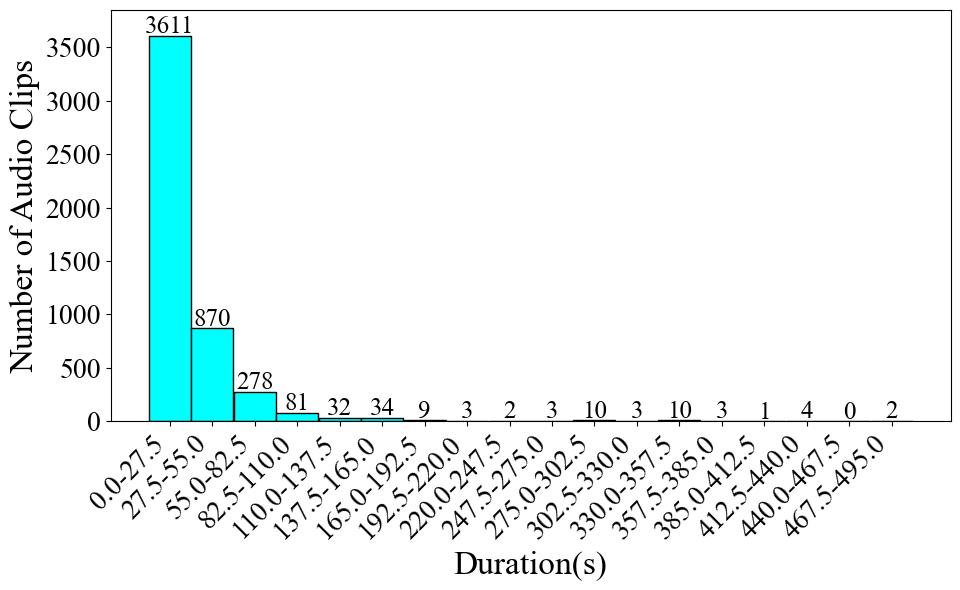
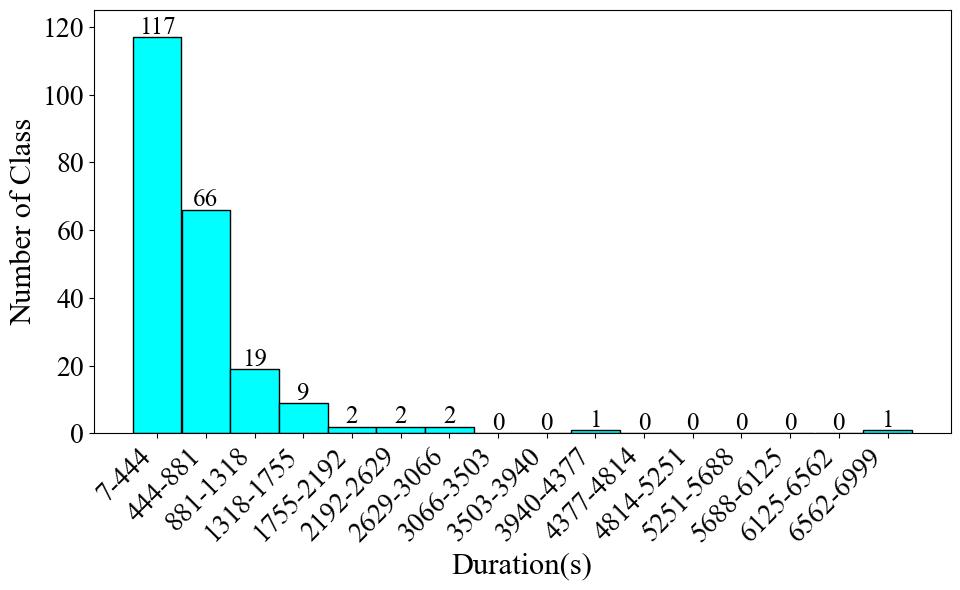
Due to the large number of categories in this dataset, we are unable to provide the audio duration per category and the proportion of audio clips by category, as we have done for the other datasets. Instead, we provide a chart showing the distribution of the number of audio clips across different durations, as shown in **Fig. 1**. A second graph, shown in **Fig. 2**, shows the distribution of instrument categories over various durations. From **Fig. 1**, 3611 clips (73%) are concentrated in the range 0-27.5 s, with a steep drop in the number of samples in longer durations. In **Fig. 2**, about half of the instruments, totaling 117, have a duration of less than 437 seconds, while 102 instruments have a duration greater than this number. After the total duration exceeds 881 seconds, the number of instruments drops sharply. This indicates that the dataset has a certain degree of class imbalance.
| Statistical items | Values |
| :------------------------------------------: | :-------------------: |
| Total count | `4956` |
| Total duration(s) | `117482.75025085056` |
| Mean duration(s) | `23.705155417847124` |
| Min duration(s) | `0.27639583333333334` |
| Max duration(s) | `494.2522902494331` |
| Instrument types | `209` |
| Label Numbers | `219` |
| Eval subset total | `43054` |
| Class with the longest audio duartion | `中阮 (Zhong1 ruan3)` |
| Class in the longest audio duartion interval | `箜篌 (Kong1 hou2)` |
## Maintenance
```bash
GIT_LFS_SKIP_SMUDGE=1 git clone git@hf.co:datasets/ccmusic-database/CTIS
cd CTIS
```
## Mirror
<https://www.modelscope.cn/datasets/ccmusic-database/CTIS>
## Dataset Description
### Dataset Summary
A dataset of Chinese instrument audio
### Supported Tasks and Leaderboards
MIR, audio classification
### Languages
Chinese, English
### Data Instances
.zip(.wav), .csv
### Data Fields
219 Chinese instruments
### Data Splits
train, validation, test
## Usage
### Default Subset
```python
from datasets import load_dataset
dataset = load_dataset("ccmusic-database/CTIS", name="default", split="train")
for item in dataset:
print(item)
```
### Eval Subset
```python
from datasets import load_dataset
dataset = load_dataset("ccmusic-database/CTIS", name="eval")
for item in ds["train"]:
print(item)
for item in ds["validation"]:
print(item)
for item in ds["test"]:
print(item)
```
## Additional Information
### Dataset Curators
Zijin Li
### Evaluation
[1] [Liang, Xiaojing et al. “Constructing a Multimedia Chinese Musical Instrument Database.” Lecture Notes in Electrical Engineering (2019): n. pag.](https://link.springer.com/content/pdf/10.1007/978-981-13-8707-4_5.pdf)<br>
[2] [Li, R., & Zhang, Q. (2022). Audio recognition of Chinese traditional instruments based on machine learning. Cogn. Comput. Syst., 4, 108-115.](https://ietresearch.onlinelibrary.wiley.com/doi/pdf/10.1049/ccs2.12047)<br>
[3] <https://huggingface.co/ccmusic-database/CTIS><br>
### Citation Information
```bibtex
@inproceedings{10.1007/978-981-13-8707-4_5,
author = {Xiaojing Liang and Zijin Li and Jingyu Liu and Wei Li and Jiaxing Zhu and Baoqiang Han},
booktitle = {Proceedings of the 6th Conference on Sound and Music Technology (CSMT)},
pages = {53-60},
publisher = {Springer Singapore},
address = {Singapore},
title = {Constructing a Multimedia Chinese Musical Instrument Database},
year = {2019}
}
```
### Contributions
An audio dataset for Chinese Instrument |