
Introducing Fasih-TTS-V1: a #1-Intelligibility Arabic (Fusha) Voice — and an Open Benchmark to Back It Up


Arabic is spoken by more than 400 million people, yet Modern Standard Arabic (Fusha) is still poorly served by open text-to-speech — and, just as importantly, there is almost no rigorous, reproducible way to evaluate Arabic TTS. The team behind the excellent SILMA benchmark said it plainly: standard metrics "are often insufficient for accurately capturing the nuances of Arabic speech," so they fell back to human listening.
Today I'm releasing Fasih-TTS-V1 (فَصِيح, "eloquent") — a professional male Fusha voice fine-tuned from Coqui XTTS v2 — together with the evaluation infrastructure the ecosystem was missing: an open, reproducible, two-ASR-judge benchmark and a fully-scored dataset. Fasih ranks #1 for intelligibility on the SILMA benchmark across both judges — and I'm publishing every clip, transcript, and score so anyone can check the claim line by line.
What I'm releasing
This is a complete, open release — not just weights:
- The model — NightPrince/Fasih-TTS-V1: a single-speaker Arabic (MSA/Fusha) male voice with a built-in diacritization + text front-end.
- An open benchmark dataset — NightPrince/Fasih-TTS-Benchmark: 31 scored clips plus the full 6-model SILMA comparison, with per-clip references, ASR transcriptions, and WER/CER for total transparency.
- A live demo — NightPrince/Fasih-TTS on ZeroGPU: type Arabic (even without diacritics) and hear it.
- The full pipeline, open — github.com/NightPrinceY/Fasih-TTS-V1: data validation, CATT diacritization, training, a two-judge evaluation harness, a FastAPI streaming server, and a deployable NVIDIA NeMo Arabic STT service.
Table of contents
- Why this matters
- What Fasih is
- How I built it
- Architecture
- An honest, two-judge benchmark
- Listen for yourself
- Get started
- Limitations
- What's next, and how to contribute
- License and citation
- Acknowledgments
Why this matters
Three things make Fusha genuinely hard, and each shaped the release:
- Diacritics decide pronunciation. Written MSA drops short vowels, but broadcast-quality Fusha
pronounces full case endings (iʿrāb).
العلمis al-ʿilm ("knowledge") or al-ʿalam ("flag") depending on marks that real text omits. A model fed raw text is guessing. - The text front-end matters as much as the acoustic model. Numbers, abbreviations, and sacred/technical vocabulary must be normalized before a single sample is generated.
- Evaluation is unsolved in the open. Without a shared, reproducible way to measure Arabic TTS, "state of the art" claims can't be checked — which is exactly the gap this release targets.
Fasih was built for a real product — a spoken religious-Q&A assistant — where a mispronounced word is unacceptable. That priority pointed the whole project at correctness first, and made honest measurement non-negotiable.
What Fasih is
| Voice | Single professional male, news-anchor register |
| Language | Modern Standard Arabic (Fusha) |
| Base model | Coqui XTTS v2 (fine-tuned) |
| Diacritization | Built-in CATT — handles even undiacritized input |
| Front-end | normalize → number expansion → tashkīl → sacred-term lexicon → chunking |
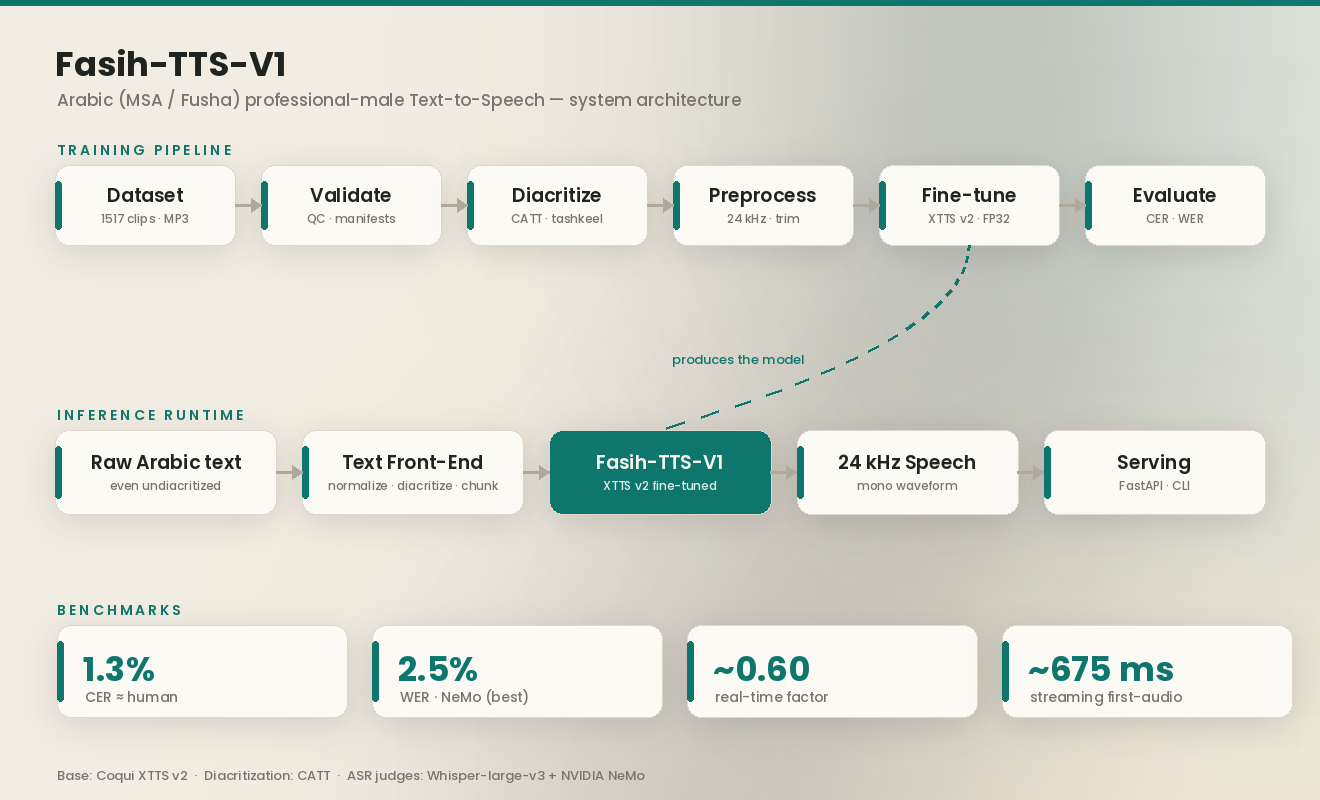
| Output | 24 kHz mono · RTF ≈ 0.6 · streaming first-audio ≈ 675 ms |
| Intelligibility | #1 on the SILMA benchmark (both ASR judges) |
| License | Coqui Public Model License (non-commercial) |
How I built it
Data: 2.4 hours, fully diacritized
The training set is 1,517 single-speaker clips (~2.9 h), mono. A full audit showed clean audio — consistent sample rate, no clipping, steady loudness — with one real gap: 371 clips (24%) had undiacritized transcripts. Because mixing diacritized and plain text teaches inconsistent pronunciation, I auto-diacritized those with CATT, a SOTA encoder-decoder Arabic diacritizer. A sanity check — strip a gold clip's diacritics, re-diacritize, compare — reproduced the human tashkīl almost character-for-character. After preprocessing and dropping over-long clips, the fine-tune set was 1,297 clips (~2.4 h).
The Arabic text front-end
At inference, raw text flows through a small pipeline before it reaches the model:
normalize → expand numbers → diacritize (if needed) → sacred-term lexicon → chunk
Two Arabic-specific gotchas worth sharing:
- Diacritics inflate character count. XTTS caps Arabic input at 166 characters, and a fully diacritized sentence can be ~1.7× longer than its bare form — so long responses must be chunked at sentence/clause boundaries and stitched back together.
- Number gender agreement (
خمسvsخمسة) is subtle;num2wordsis right most of the time, not always.
The training journey: Turing forces FP32
I trained on RTX 2080 Ti (Turing, sm_75) GPUs — and hit a wall worth documenting:
- BF16? Not supported on Turing.
- FP16 (mixed precision)? XTTS's GPT head overflowed and produced
NaNloss under FP16 autocast, from the very first step, while eval (autocast off) stayed finite — a genuinely confusing bug.
The fix was to train in FP32, the only stable precision here. That doubles memory, so I used
batch_size=1 with grad_accum=24, gradient checkpointing, and
PYTORCH_CUDA_ALLOC_CONF=expandable_segments:True to fit 11 GB alongside other jobs. Best validation
loss: 2.622. If you ever fine-tune XTTS on older hardware and see instant NaNs — now you know why.
Architecture
An honest, two-judge benchmark
This is the contribution I'm proudest of. It is easy to post a single self-reported WER and declare victory. I wanted numbers I would trust — and that the community can reproduce — so I:
- took the 10 fixed MSA sentences from the SILMA benchmark,
- pulled every competing model's audio straight from the benchmark Space,
- synthesized Fasih on the same sentences with its full front-end, and
- scored all six models with two independent ASRs — Whisper-large-v3 and NVIDIA NeMo Arabic FastConformer — then added UTMOS for naturalness.
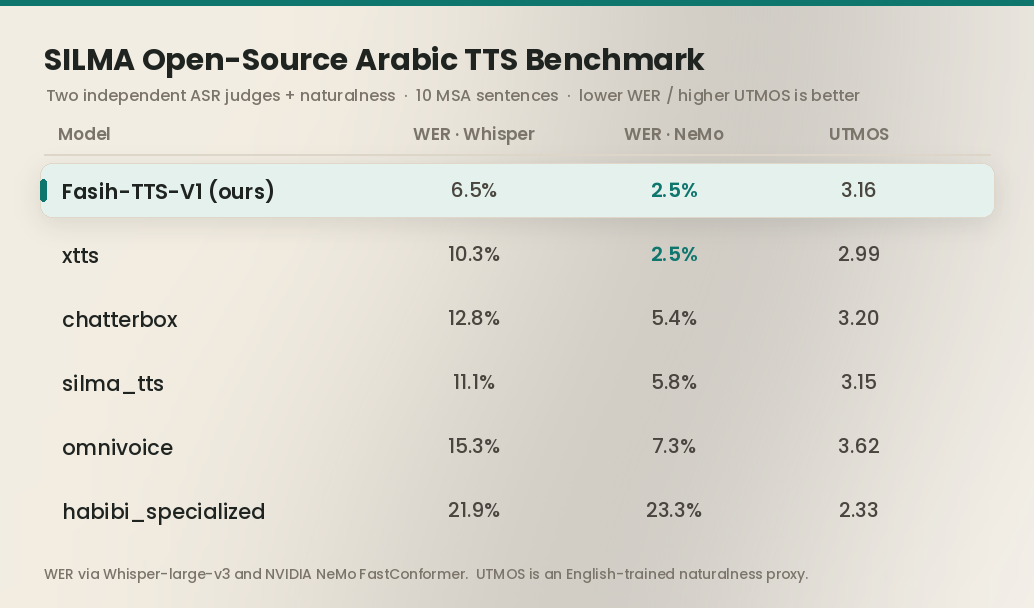
| Model | WER · Whisper | WER · NeMo | UTMOS |
|---|---|---|---|
| Fasih-TTS-V1 (ours) | 6.5 | 2.5 | 3.16 |
| xtts (base) | 10.3 | 2.5 | 2.99 |
| chatterbox | 12.8 | 5.4 | 3.20 |
| silma_tts | 11.1 | 5.8 | 3.15 |
| omnivoice | 15.3 | 7.3 | 3.62 |
| habibi_specialized | 21.9 | 23.3 | 2.33 |
What using two judges reveals — and one wouldn't:
- Intelligibility: Fasih has the best-or-tied lowest WER on both ASRs — a clear lead on Whisper, tied with base XTTS on the stronger Arabic ASR (NeMo). A single Whisper run would have overstated the lead; the second judge keeps it honest.
- Naturalness: on UTMOS, Fasih is #3, not #1. The smoothest-sounding model (
omnivoice) is also the least accurate (15.3% WER). Fasih is deliberately tuned toward pronunciation correctness — the right trade-off for a religious assistant, and I won't pretend otherwise.
Every per-clip reference, transcription, and score is in the benchmark dataset, and the whole thing reruns from two scripts. That reproducibility — not the ranking itself — is what I hope is useful to the next person building Arabic TTS. (UTMOS is English-trained, so treat its absolute Arabic values as a proxy; the real naturalness test remains human listening.)
Listen for yourself
Same sentences, three models — trust your ears.
*A classical verse — الخيل والليل والبيداء تعرفني…*
| Fasih (ours) | XTTS (base) | SILMA TTS |
|---|---|---|
A modern sentence — تحدث النوبة القلبية عندما يتوقف سريان الدم لجزء من القلب
| Fasih (ours) | XTTS (base) | SILMA TTS |
|---|---|---|
Get started
The fastest path is the live ZeroGPU demo — type Arabic (even without diacritics) and it adds tashkīl automatically. Or load it directly:
from huggingface_hub import snapshot_download
from TTS.tts.configs.xtts_config import XttsConfig
from TTS.tts.models.xtts import Xtts

path = snapshot_download("NightPrince/Fasih-TTS-V1")
config = XttsConfig(); config.load_json(f"{path}/config.json")
model = Xtts.init_from_config(config)
model.load_checkpoint(config, checkpoint_path=f"{path}/model.pth",
                      vocab_path=f"{path}/vocab.json", use_deepspeed=False)
model.cuda().eval()

gpt_cond, spk = model.get_conditioning_latents(audio_path=["reference.wav"])
out = model.inference("السَّلَامُ عَلَيْكُمْ وَرَحْمَةُ اللَّهِ", "ar", gpt_cond, spk,
                      temperature=0.65, repetition_penalty=2.0)
The full production front-end and a FastAPI streaming server are in the repository.
Limitations
- Naturalness is good, not best — UTMOS #3; the model favors correctness over smoothness.
- Number gender agreement isn't always right.
- Source audio is 128 kbps MP3 (no lossless originals) — a soft ceiling on fidelity.
- ~2.4 h, single speaker — excellent for its domain; long-form prosody can still improve.
- Qur'anic recitation is out of scope — it requires tajwīd and human reciters, not TTS.
What's next, and how to contribute
Arabic TTS gets better faster when the evaluation is open. If you build Arabic voices, please:
- Run the harness on your model — the two-judge scripts and dataset make an apples-to-apples comparison a few commands away.
- Extend the benchmark — more sentences, dialects, or a third ASR judge are all welcome.
- Help with naturalness — a human Arabic listening study is the missing piece UTMOS only proxies.
On my side: an F5-TTS challenger, FP16 inference to roughly halve the 675 ms latency, and a context-aware Arabic number normalizer.
License and citation
Fasih is fine-tuned from Coqui XTTS v2 and distributed under the Coqui Public Model License — non-commercial, attribution required; derivatives inherit these terms.
@software{fasih_tts_v1_2026,
  author = {Yahya Elnawasany (NightPrince)},
  title  = {Fasih-TTS-V1: Arabic Fusha Professional-Male Text-to-Speech},
  year   = {2026},
  url    = {https://github.com/NightPrinceY/Fasih-TTS-V1},
  note   = {Fine-tuned from Coqui XTTS v2}
}
Acknowledgments
Built on Coqui XTTS v2; diacritization by CATT; benchmark sentences and competitor audio from SILMA AI; ASR judges Whisper-large-v3 and NVIDIA NeMo FastConformer; hosting and ZeroGPU by Hugging Face.
By Yahya Elnawasany (NightPrince) — portfolio. If Fasih or the benchmark helps your work, a star on the repo and a note on what you built would mean a lot.